


Vitamin D and cancer
What is vitamin D
Vitamin D is a fat-soluble vitamin that also functions as a hormone in the body. It plays a crucial role in regulating calcium and phosphorus metabolism, which is essential for maintaining healthy bones and teeth. Vitamin D is naturally formed in the skin when exposed to sunlight and is also found in foods such as fatty fish, egg yolks, and fortified dairy products. In addition to its bone-strengthening properties, vitamin D has an important function in the immune system and may be associated with a lower risk of certain types of cancer, including breast, colon, and prostate cancer. The active form of vitamin D, calcitriol, inhibits cancer cell growth and promotes apoptosis, which underscores vitamin D’s importance for both bone health and overall health [7, 17, 20].
Research indicates that adequate levels of vitamin D may be associated with a lower risk of developing certain types of cancer, such as breast, colon, and prostate cancer. It is believed that vitamin D can inhibit cancer cell growth and promote apoptosis (programmed cell death), making it an important factor in cancer research and treatment. Therefore, vitamin D deficiency can have serious consequences, not only for bone health but also for overall health and cancer risk [7, 17, 20].
Use of vitamin D
Dietary supplements
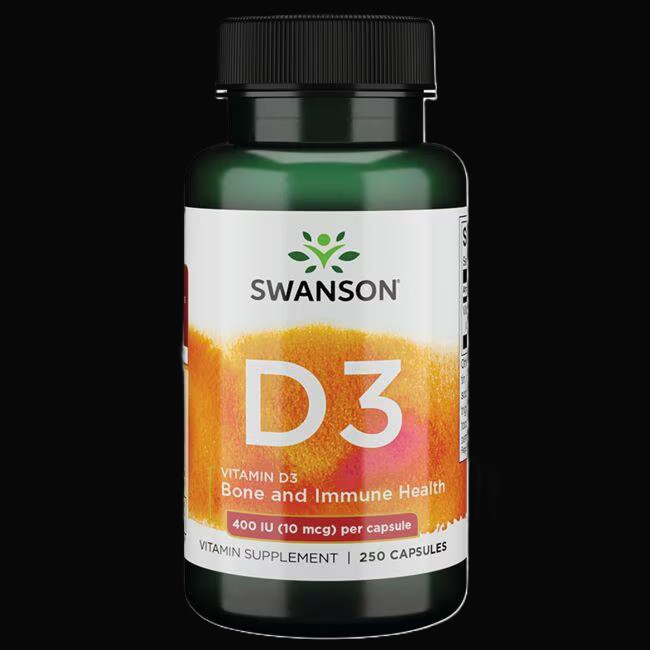
Many people do not get enough vitamin D through diet alone, especially during the darker months. Therefore, many people take vitamin D supplements.
Medication
In some cases, vitamin D can be prescribed as medication to treat certain diseases, such as rickets (softening of the bones in children) and osteomalacia (softening of the bones in adults).
Effect of vitamin D
Bone health
Vitamin D is crucial for maintaining strong bones and teeth by helping the body absorb calcium and phosphorus.
Immune system
Vitamin D plays a role in strengthening the immune system and protecting against infections [1, 3, 6].
Muscle strength
Vitamin D is also important for muscle strength and function.
Mood
Some studies suggest that vitamin D can have a positive effect on mood and prevent depression.
Benefits of vitamin D
Prevention of bone diseases:
Vitamin D can help prevent osteoporosis and rickets.
Strengthened immune system:
A strong immune system can protect against a number of diseases.
Reduced risk of certain diseases:
Some studies suggest that vitamin D can reduce the risk of certain types of cancer, cardiovascular diseases, and autoimmune diseases [7, 17, 20].
The real risk of overdose
Although vitamin D is essential, it is a fat-soluble vitamin, which means that the body does not excrete excess amounts through urine (as it does with, for example, vitamin C). Instead, vitamin D accumulates in the body’s fatty tissue and in the liver.
Therefore, ingestion of extremely high doses over a long period can lead to a poisoning condition.
What is vitamin D poisoning (Hypervitaminosis D)
Claims (such as Milena Penkowa allegedly presents in her book: Menopause) that vitamin D poisoning “does not exist” are in direct contradiction to medical science. The condition is well-defined and known as hypervitaminosis D.
The danger of hypervitaminosis D is not the vitamin itself, but its direct consequence: hypercalcemia.
Hypercalcemia:
Means that the level of calcium in the blood becomes dangerously elevated. Vitamin D’s primary function is to increase the absorption of calcium from the intestines. With extreme doses, the body is “forced” to absorb much more calcium than it needs.
This elevated calcium level in the blood can lead to:
- Nausea, vomiting, constipation, and stomach pain.
- Fatigue, dizziness, and cognitive confusion.
- Severe thirst and frequent urination, as the kidneys attempt to excrete the excess calcium.
Persistent hypercalcemia is serious and can lead to:
- Deposition of calcium in soft tissues (e.g., blood vessels and heart valves).
- Kidney stones.
- Permanent kidney damage and kidney failure.
According to the Danish Endocrine Society, severe hypercalcemia can develop into a “hypercalcemic crisis,” which is an “acute life-threatening condition” [13].
Recommendations vs. extreme doses
The official Danish recommendations for vitamin D are typically 10-20 micrograms (400-800 IU) daily.
The European Food Safety Authority (EFSA) has set the upper tolerable limit (the maximum amount that can be safely ingested daily over time) at 100 micrograms (4,000 IU) for adults.
Doses mentioned in certain circles, such as 60,000 IU, 80,000 IU, or even 120,000 IU daily, are thus 15 to 30 times higher than the established safe maximum limit. Intake at this magnitude is, according to health authorities, directly associated with a serious risk of toxicity, which is confirmed in a case from the UK where an 89-year-old man’s death in 2023 was officially attributed to vitamin D poisoning [11].
The critical confusion about blood levels (nmol/L vs. ng/ml)
A central source of misinformation is a dangerous confusion of the units of measurement used for blood tests.
- In Denmark and most of Europe, vitamin D is measured in nmol/L (nanomoles per liter).
- In the USA, ng/ml (nanograms per milliliter) is often used.
The conversion factor is approximately 2.5 (1 ng/ml ≈ 2.5 nmol/L).
The Danish reference values for blood content (measured in nmol/L) are:
- Optimal level: 50 – 120 nmol/L
- Mild deficiency: 25 – 50 nmol/L
- Severe deficiency: < 25 nmol/L
- Toxic (poisonous) level: > 200 nmol/L [8]
When reference is made (as Milena Penkowa tends to do) to alleged “beneficial” levels of, for example, 200 ng/ml or “healing” levels of 450-500 ng/ml, these figures are based on the American unit of measurement.
Converted to the Danish values (nmol/L), which are used by Danish doctors, the calculation looks like this:
- Claim (200 ng/ml): 200 x 2.5 = 500 nmol/L (Twice as high as the toxic limit)
- Claim (450 ng/ml): 450 x 2.5 = 1125 nmol/L (More than 10 times higher than the optimal level)
The blood levels that are promoted in certain circles as healing are therefore, in medical terms, the definition of a serious poisoning condition. This connection is confirmed by Ugeskrift for Læger, which states that “Poisonings with vitamins” can lead to hypercalcemia [12].
Danish hospitals also have specific procedures for handling “vitamin D poisoning” in adults [9, 10].
How vitamin D works against cancer
The precise mechanism by which vitamin D affects cancer cells is still under intense research. But here are some of the possible mechanisms:
Immune system
As mentioned above, vitamin D can strengthen the immune system, making the body better equipped to combat cancer cells [1, 3, 6].
Cell death
Vitamin D can induce programmed cell death (apoptosis) in cancer cells, leading to their destruction.
Cell differentiation
Vitamin D can affect cancer cell growth and division by promoting cell differentiation, which can slow tumor growth.
Blood vessel development
Vitamin D can inhibit the formation of new blood vessels that cancer tumors need to grow [5, 6].
Benefits of vitamin D as complementary treatment
Prevention
Some studies suggest that people with adequate levels of vitamin D have a lower risk of developing certain types of cancer, such as colon cancer and breast cancer [7, 17, 20].
Treatment
Vitamin D can potentially improve the effect of conventional cancer treatments, such as chemotherapy and radiation therapy. It can also be used together with other dietary supplements, as part of alternative cancer treatment [5, 6].
Side effects
Vitamin D is generally considered safe, and side effects are rare at recommended doses.
What does the research say
Although there are promising results from both animal studies and observational studies, more research is needed to establish the exact role of vitamin D in cancer prevention and treatment. Larger clinical trials are necessary to confirm whether vitamin D supplements should be recommended as a standard treatment for cancer patients.
Note
Vitamin D supplements should not stand alone as treatment against cancer. But it can be a good supplement to other relevant treatment.
Make sure to maintain a sensible balance. Vitamin D can be overdosed.
Conclusion
Vitamin D is an essential nutrient that functions as a hormone in the body and plays an important role in regulating calcium and phosphorus metabolism, which is crucial for bone health. In addition to its known benefits for bones and the immune system, research shows that vitamin D can also have a significant impact on cancer. Several studies indicate that adequate levels of vitamin D may be associated with a lower risk of certain types of cancer, including breast and colon cancer, as well as improving the effect of conventional treatments such as chemotherapy and radiation therapy [7, 17, 20].
Although vitamin D is generally considered safe and has few side effects at recommended doses, it is important to be aware of the risk of overdose, which can lead to serious health problems. There is still a need for more research to clarify the precise mechanisms behind vitamin D’s influence on cancer and to determine how it can best be used as part of a holistic treatment plan. As a supplement to conventional treatment, vitamin D can offer valuable support to cancer patients and contribute to improving their quality of life and treatment effectiveness.
Take a quiz (Danish Language)
You can find more Quizzes here
Also see Mitochondrial stem cell connection in cancer treatment, targeting
Links
[1] Vitamin D: What role in obesity-related cancer? (PubMed, 2025)
- Content: Although vitamin D can counteract many of the cancer-promoting effects associated with obesity (such as inflammation and insulin resistance), its protective effect is limited. This is because excess fatty tissue binds and “traps” vitamin D, which reduces its availability in the body.
[2] The genetic landscape of CYP24A1 polymorphisms in cancer risk: evidence from a systematic review (PubMed, 2025)
- Content: According to a new, large review article, genetic variations in the vitamin D-metabolizing gene CYP24A1 are directly associated with a person’s risk of developing cancer. Depending on the specific gene variant, a person may have either an increased or decreased risk of developing breast, prostate, and thyroid cancer, among others.
[3] Beneficial health effects of ultraviolet radiation: expert review and conference report (PubMed, 2025)
- Content: A new expert review challenges restrictive sun recommendations and highlights that the many health benefits of sunlight beyond vitamin D formation (such as lower blood pressure) are associated with a longer overall lifespan. Researchers call for a better balance between warnings about skin cancer and the documented positive effects of the sun in official health advice.
[4] The effect of vitamin D supplementation on cancer incidence in the randomised controlled D-Health Trial: Implications for policy and practice (PubMed, 2025)
- Content: A large, new study with over 21,000 participants confirms that vitamin D supplements do not prevent the development of cancer. Since vitamin D is known to reduce the mortality of cancer, researchers conclude that the beneficial effect is instead likely due to improved survival after the diagnosis is made.
[5] Ferroptosis induction, androgen biosynthesis disruption and prostate cancer suppression by androgen and vitamin D combination (PubMed, 2015)
- Content: A low, safe dose of active vitamin D (calcitriol), which is ineffective alone, becomes a potent cancer inhibitor against resistant prostate cancer (CRPC) when combined with a normal level of male sex hormone. The combination works by both forcing the cancer cell to break down its own fuel (androgens) and by triggering a specific type of cell death called ferroptosis.
[6] Vitamin D and Immune Checkpoint Inhibitors in Lung Cancer: A Synergistic Approach to Enhancing Treatment Efficacy (PubMed, 2025)
- Content: Vitamin D shows significant potential to improve the effect of immunotherapy (ICIs) against lung cancer. It works by regulating the immune system and dampening inflammation directly in the tumor’s microenvironment, which can overcome resistance and enhance treatment.
[7] Forskere fastslår sammenhæng mellem D-vitamin og kræft (Onkologisk Tidsskrift, 2024)
- Content: A large, Danish-led study, based on data from 1.5 million Danes, confirms a clear connection between low vitamin D and increased cancer risk. The study shows, as something new, that vitamin D’s positive effect is likely due to its ability to affect the gut flora and thus strengthen the body’s immune response against cancer. (Danish Language)
[8] Vitamin D (Lægehåndbogen på Sundhed.dk, 2023)
- Content: A medical review of vitamin D from Lægehåndbogen. The article describes that vitamin D poisoning (hypervitaminosis D) is a recognized condition that occurs with excessive intake. It describes how this leads to hypercalcemia (elevated calcium in the blood) and risk of serious symptoms, including kidney effects. (Danish Language)
[9] Hypercalcæmi (Lægehåndbogen på Sundhed.dk, 2024)
- Content: The article is written for doctors and states “Vitamin D poisoning” as a specific cause of hypercalcemia (elevated calcium). It describes that treatment with steroids works precisely in cases where hypercalcemia is triggered by vitamin D poisoning. (Danish Language)
[10] Mistanke om forgiftning med D-vitamin (Bispebjerg Hospital, 2016)
- Content: This guideline describes the specific blood test profile to be ordered in case of suspected poisoning and specifically distinguishes between “infants/children under 2 years” and the profile for “children over 2 years and adults.” This documents the clinical procedure for vitamin D poisoning in adults. (Danish Language)
[11] David Mitchener: Prevention of future deaths report (Courts and Tribunals Judiciary – UK, 2024)
- Content: Forensic report regarding the death of 89-year-old David Mitchener. The report conclusively concludes that the cause of death was organ failure (heart and kidneys) as well as hypercalcemia caused by “Vitamin D toxicity” (vitamin D poisoning/toxicity). His vitamin D level was at the maximum the laboratory could measure. This is an official, legal document confirming a death in an adult as a result of vitamin D poisoning.
[12] Udredning og behandling af hyperkalcæmi (Ugeskriftet.dk, 2014)
- Content: A scientific article from Ugeskrift for Læger, which directly states that “Poisonings with vitamins and minerals can also lead to hyperkalcemia.” This link establishes the medical fact that vitamin poisoning is what causes the condition. (Danish Language)
[13] Hypercalcæmi og hypercalcæmisk krise (Dansk Endokrinologisk Selskab, 2024)
- Content: A national treatment guideline from specialists in hormonal diseases (endocrinology), targeting adults. The guideline specifically excludes cases caused by the parathyroid glands (hyperparathyroidism) and instead states “Vitamin D” as a recognized cause of the condition. It defines severe hypercalcemia as an “acute life-threatening condition.” (Danish Language)
[14] Exploring vitamin D metabolism and function in cancer (PubMed)
- Content: General information about vitamin D metabolism and function in cancer.
[15] Vitamin D in liver cancer: novel insights and future perspectives (PubMed)
- Content: General information about vitamin D in liver cancer, including novel insights and future perspectives.
[16] Vitaminer og kræft (Kræftens Bekæmpelse)
- Content: General information about vitamins and cancer. (Danish Language)
[17] Forskning påviser sammenhæng mellem lavt D-vitamin og højere risiko for kræft (Århus Universitet)
- Content: General information about research showing a connection between low vitamin D and higher risk of cancer. (Danish Language)
[18] D-vitamin og kræftrisiko: Sådan bør du forholde dig til opsigtsvækkende studie (Videnskab.dk)
- Content: General information about vitamin D and cancer risk, and how one should relate to sensational studies. (Danish Language)
[19] D-vitamin og omega-3-fedtsyrer som primær prævention for kræft og hjerte-kar-sygdomme (Ugeskrift for Læger)
- Content: General information about vitamin D and omega-3 fatty acids as primary prevention for cancer and cardiovascular diseases. (Danish Language)
[20] Dansk forskning viser sammenhæng mellem D-vitamin og kræft (DR-Nyheder)
- Content: General information about Danish research showing a connection between vitamin D and cancer. (Danish Language)
Page created: August 14, 2024, Last revised November 2, 2025
❤
What you read on “Jeg har Kræft” is not a recommendation. Seek competent guidance.
