

Treatments
Complementary and Alternative Treatments

The COC protocol
Purpose of the COC protocol?
The COC protocol is an alternative cancer treatment developed by the Care Oncology Clinic in London. It aims to combat cancer by using a combination of well-known and approved drugs, each of which has shown positive effects on cancer cells.
How the COC protocol works?
The COC protocol works by blocking the cancer cells’ pathways for nutrients using four different drugs: Metformin, Statin, Vermox, and Doxycycline. These drugs affect the cancer cells’ energy consumption and metabolism, making it harder for the cancer cells to survive and divide. The treatment can thus lead to the cancer cells being weakened and dying.
Advantages and disadvantages of the COC protocol?
The advantages of the COC protocol include the use of well-known drugs with few (or no) side effects and a broad effect against various forms of cancer. Disadvantages include the lack of approval from the Health Authority, and thus the protocol is considered experimental treatment. No actual public subsidy is provided for the medicine.
Who can benefit from the COC protocol?
The COC protocol can potentially help all cancer patients, as it targets fundamental processes in cancer cells that are common to most forms of cancer. This multi-dimensional approach can be quite effective by attacking the cancer cells’ metabolism from different angles, which can reduce the risk of the cancer developing resistance. Some use the protocol instead of conventional treatment. Others as a supplement after traditional treatment to minimize the risk of recurrence.
Are there other disadvantages of the COC protocol?
Disadvantages of the COC protocol are (in addition to the lack of approval from the Health Authority) that prescription drugs are included. And not all doctors have sufficient knowledge of this protocol to be willing to prescribe it. Furthermore, both kidneys and liver can in rare cases be strained by the medications included, which is why it is optimally advised to have kidney and liver values checked every 3 months.
The COC Protocol against cancer
What is the COC protocol
The COC protocol is an alternative cancer treatment that has gained attention in recent years. COC stands for Care Oncology Clinic, and the protocol was developed by this clinic in London. Instead of using new, experimental drugs, the COC protocol is based on a combination of already known and approved medical substances, each of which has shown a positive effect on cancer cells.
There are thus four well-known drugs used as repurposed drugs.
How the COC protocol works
The central idea behind the COC protocol is to exploit the altered metabolism of cancer cells. Cancer cells have a different (and higher) energy consumption than normal cells, and the COC protocol attempts to exploit this difference. The four drugs included in the protocol act in different ways, but their combined effect is to make it harder for the cancer cells to absorb and utilize energy. This is referred to as blocking the cancer cells’ pathways to obtaining nutrients. This leads to the cancer cells being weakened and ultimately dying (read more about this further down). In the traditional COC protocol, all 4 preparations are taken regularly. While different versions exist, some alternate between the intake of Vermox and Doxycycline, so that only one of these is taken for a month, after which the preparation is switched to the other.
The four drugs in the COC protocol
Metformin
Diabetes type 2 medicine (1000–2000 mg daily) Originally a drug for type 2 diabetes, but it has also been shown to have anticancer effects by affecting the cells’ energy consumption.
- Primary use: Treatment of type 2 diabetes.
Mechanism of action:
- Affects AMPK: Metformin activates an enzyme called AMPK, which plays a role in cellular energy homeostasis and can have anticancer effects.
- Reduces glucose production: Metformin decreases the liver’s production of glucose (blood sugar), which is an important energy source for the body.
- Increases insulin sensitivity: It makes the body more sensitive to insulin, the hormone that helps transport glucose into the cells.
Statin
(e.g., Atorvastatin) Cholesterol medicine (80 mg daily) Statins are a type of medicine primarily used to lower cholesterol levels in the blood. Statins work by inhibiting the production of cholesterol in the liver. By reducing cholesterol levels in the blood, statins help reduce nutrients for cancer cells as they block one of the so-called pathways.
- Primary use: Lowering cholesterol levels.
Mechanism of action:
- Inhibits HMG-CoA reductase: Statins block an enzyme necessary for the production of cholesterol in the liver.
- Increases LDL receptors: This leads to an increased uptake and breakdown of LDL cholesterol in the liver (the “bad” cholesterol). This contributes to lowering total cholesterol levels and thus the nutrients available to the cancer cells.
Vermox
(Mebendazole) Deworming treatment (100 mg daily (some choose to take Vermox alternately with Doxycycline – 1 month on – 1 month break))
- Primary use: Treatment of worm infections.
Mechanism of action:
- Inhibits microtubules: Vermox interferes with the formation of microtubules, which are important for the growth and division of both worms and cancer cells.
- Causes cell death: This disruption leads to the death of the worms/cancer cells.
- Angiogenesis inhibition: Some studies suggest that Vermox can inhibit the formation of new blood vessels (angiogenesis), which are necessary for tumors to grow and spread.
- Immunomodulating effect: There are some indications that Vermox can affect the immune system and potentially strengthen the body’s own ability to fight cancer cells.
- Selective toxicity: Vermox is relatively selective toward cells that divide rapidly, such as cancer cells and worms. This can make it less toxic to normal cells.
- Low toxicity: Compared to many chemotherapeutic agents, Vermox has an extremely low toxicity profile.
Doxycyclin
Antibiotic (100 mg daily (as stated above, some choose to alternate between Doxycycline and Vermox 1 month on – 1 month break. Others take Vermox regularly and Doxycycline 1 month on – 1 month break – starting over. However, it is common to take both simultaneously.))
- Primary use: Treatment of bacterial infections.
Mechanism of action:
- Inhibits protein synthesis: Doxycycline binds to bacterial ribosomes (protein producers) and thus prevents them from producing the proteins they need to survive and multiply. Thereby, doxycycline inhibits bacterial protein synthesis. Cancer cells also divide rapidly and therefore have a high need to produce new proteins. By blocking this process, doxycycline can also prevent cancer cells from growing and dividing.
- Promoting cell death (apoptosis): Doxycycline can induce cancer cells to undergo suicide.
- Inhibiting blood vessel growth (angiogenesis): Cancer tumors need new blood vessels to grow. Doxycycline can prevent the formation of these blood vessels.
- Affecting the immune system: Some studies suggest that doxycycline can strengthen the immune system’s ability to fight cancer cells.
The potential for doxycycline in cancer treatment is due to several factors:
- Broad-spectrum effect: Doxycycline can be effective against various types of cancer cells.
- Relatively low toxicity: Compared to many chemotherapeutic agents, doxycycline has a relatively low toxicity profile.
- Availability and low price: Doxycycline is an inexpensive and easily accessible drug.
Pathways and drugs
A pathway is a sequence of interactions between molecules in a cell. Drugs can affect these pathways by binding to specific molecules or by affecting enzymes that catalyze certain reactions. For the four drugs in the COC protocol, the following applies:
- Metformin: Affects insulin signaling and gluconeogenesis (the production of glucose in the liver) and thus affects insulin and glucose pathways.
- Statin: Inhibits HMG-CoA reductase, an enzyme involved in cholesterol synthesis. Thus, the cholesterol synthesis pathway is affected.
- Vermox: Inhibits tubulin polymerization, a process necessary for the growth and division of worms – but also for cancer cells. This is interesting as it has been shown that cancer cells have a lot in common with parasites. Vermox thus affects the microtubule polymerization pathway. See also further down.
- Doxycycline: Inhibits protein synthesis in bacteria by binding to the bacterial ribosome. Apparently, this affects the protein synthesis pathway in the cancer cells.
Note: The effect of drugs can vary from person to person, and there may be a risk of interactions with other medicine.
Similarities between cancer cells and parasites
There are quite remarkable similarities between cancer cells and parasites, even though they are very different organisms. This is one of the factors utilized in connection with the composition of the COC protocol. Here are some of the most significant similarities:
- Survival: Both cancer cells and parasites are masters at surviving and thriving in their host organism. They have developed mechanisms to avoid the immune system, obtain nutrients, and multiply.
- Independence: Like parasites, cancer cells have become independent of the normal control mechanisms in the body. They ignore signals to stop dividing and can invade and destroy surrounding tissue.
- Adaptability: Both cancer cells and parasites are incredibly adaptable. They can develop resistance to treatments and change their properties to survive in different environments.
- Energy utilization: Cancer cells and some parasites have developed efficient ways to utilize their host organism’s resources. They can redirect nutrients and energy away from the host cells to support their own growth.
- Immune system: Parasites manipulate the immune system in the same way as cancer cells. This relationship is exploited in connection with the use of agents against parasites (Vermox) as an immunotherapeutic strategy to fight cancer.
Why the COC protocol is believed to work
Adaptability of cancer cells:
Cancer cells are incredibly skilled at exploiting the growth opportunities they can obtain. They can find ways to bypass treatments, especially if they are only exposed to one or two types at a given time. This results in the cancer cells developing resistance.
Preventing resistance:
To combat this ability to form resistance, it can be (according to proponents of the COC protocol) crucial to attack the cancer from several fronts simultaneously. This is best achieved by using several different substances, each of which attacks the cancer in a unique way. This prevents the cancer from developing resistance to a single type of treatment.
Applying a broad approach:
Based on this view, relying on a single treatment, such as chemotherapy, radiation therapy, Metformin, hyperthermia, Doxycycline, dietary supplements, or whatever it may be, might not be sufficient. Cancer requires in many contexts a more comprehensive strategy. Otherwise, we would not see recurrence after treatment.
The combination of “repurposed drugs” (new uses for existing drugs) and conventional treatment is believed to be able to provide a significantly more powerful blow against cancer than if one of these treatments stands alone. However, many also choose to opt out of conventional treatment entirely and rely solely on repurposed drugs, typically in combination with dietary supplements.
Who can benefit from the COC protocol
The COC protocol can potentially help all cancer patients, as it targets fundamental processes in cancer cells that are common to most cancer types.
Advantages:
- Well-known drugs with low costs
- Few side effects
- Broad effect against various forms of cancer
- The combination apparently blocks the cancer cells’ metabolism to a certain extent
Disadvantages:
- Lack of approval from the Health Authority
- Considered experimental treatment (which might not be so critical if it works)
- Limited scientific evidence (naturally, as there are no financial interests in researching the effect of medicine that can no longer be patented)
- May have unknown long-term side effects (but untreated cancer does as well)
Possible side effects of long-term use
Long-term use of medicine can lead to both desired and undesired effects. Here, however, the side effects must be weighed against the serious indication for its use. If recurrence of cancer can be avoided, it seems fantastic.
Metformin
Common side effects: Nausea, diarrhea, abdominal pain. These side effects often subside over time.
Long-term side effects:
B12 deficiency:
- Metformin can affect the absorption of vitamin B12, which over time can lead to anemia. Regular blood tests can reveal this.
Lactic acidosis:
- A rare but serious condition where lactic acid accumulates in the blood. The risk increases with kidney disease, heart failure, or alcohol abuse. Therefore, it is normal to measure kidney values at appropriate intervals (typically every quarter).
Statin
Common side effects: Muscle soreness, headache, dizziness.
Long-term side effects:
- Muscle pain and Q10: Statins can cause muscle pain because the medicine depletes the muscle cells of the co-enzyme Q10.
- Solution: Many can avoid these pains and continue treatment by taking a Q10 supplement (typically 100–200 mg daily).
- Liver impact: Statins can affect the liver. Most tolerate it fine, but the values should be checked via blood tests.
Vermox (mebendazole)
Common side effects: Abdominal pain, diarrhea, nausea.
Long-term side effects: Generally well tolerated: Vermox is normally well tolerated during short-term treatment. However, long-term use can lead to gastrointestinal problems.
Doxycycline
Common side effects: Abdominal pain, nausea, diarrhea.
Long-term side effects:
- Tooth discoloration: In children, doxycycline can cause permanent discoloration of the teeth.
- Increased sensitivity to the sun: The drug can make the skin more sensitive to sunlight.
- Fungal infections: Long-term use can increase the risk of fungal infections.
Note
It is necessary to talk to your doctor before you can be prescribed the COC protocol, as the medicine is prescription-only in Denmark. Furthermore, be aware that certain drugs can interact so that unintended effects may occur when these are combined. If in doubt, it can be checked here:
Synergy:
- The four drugs work together in a way that enhances their individual effects.
Targeted attack:
- The COC protocol attacks the cancer cells’ weaknesses, namely their altered metabolism.
Few side effects:
- Since the drugs are well-known, the side effects are generally mild compared to most other cancer treatments.
Dietary supplements
Since cancer in some situations has a disturbing ability to mutate and become resistant to treatment, I believe it is of importance to make life as difficult as possible for the cancer cells. This includes dietary supplements. Therefore, I believe it is recommendable to supplement with various ones, so that the broadest possible attack is made against the cancer’s pathways (with reservations for interaction between different preparations).
See also Dietary supplements and Chemo – Interactions
Choice of treatment
Whether one chooses to rely exclusively on conventional treatment, or decides to use a combination, or as for some, chooses complementary treatment alone, one must be aware that once diagnosed with cancer, there are no guarantees (there never are in life, but one is usually not quite as aware of this fact). It is with the COC protocol as with other medicine (including conventional), it is not in all cases that the effect is exactly as desired.
For my own part, I have chosen surgery and opted out of chemotherapy and radiation therapy. But I am not young or have small children. Anyone who receives a cancer diagnosis is in a unique situation where many thoughts, possibilities, and considerations must be weighed. Therefore, this – as with everything else on these pages – is not a recommendation, because partly I am not a doctor and thus do not have the necessary capacity to assess what is best, and partly I do not know your situation, so I have no possibility of having an opinion. That said, I will nevertheless continue to mention what I – personally – find essential.
Read also The Decision.
Important warnings

Even though the drugs are approved, it can be risky to combine them with certain cancer treatments.
CT scans with contrast
If you are to have a CT scan with contrast fluid (iodine), you must often pause Metformin for 48 hours before and after the examination.
Why:
- The combination of contrast fluid and Metformin can in rare cases trigger acute kidney failure and lactic acid poisoning (lactic acidosis) if your kidneys are already strained.
Immunotherapy
Be very cautious with Doxycycline (antibiotics) if you receive immunotherapy (e.g., Keytruda, Opdivo, or Yervoy).
Why:
- Immunotherapy is dependent on a healthy gut flora to work.
- Since antibiotics kill gut bacteria, new research shows that the effect of immunotherapy can be significantly reduced or completely absent.
Grapefruit
You must not eat grapefruit or drink grapefruit juice when taking statins (cholesterol medicine).
Why:
- Grapefruit contains substances that block the liver’s breakdown of the medicine.
- This means that the concentration of statins in the blood rises to unintended levels, which increases the risk of serious muscle damage.
Extra pressure on the bone marrow
Both chemotherapy and Mebendazole (deworming treatment) can lower the count of white blood cells (neutropenia).
Why:
- If your counts are already at rock bottom due to chemo, the addition of Mebendazole can make you extra vulnerable to infections. Therefore, keep a close eye on your blood tests.
Safety
Always consult your practitioner before starting a protocol.
Important regarding chemotherapy and low platelets
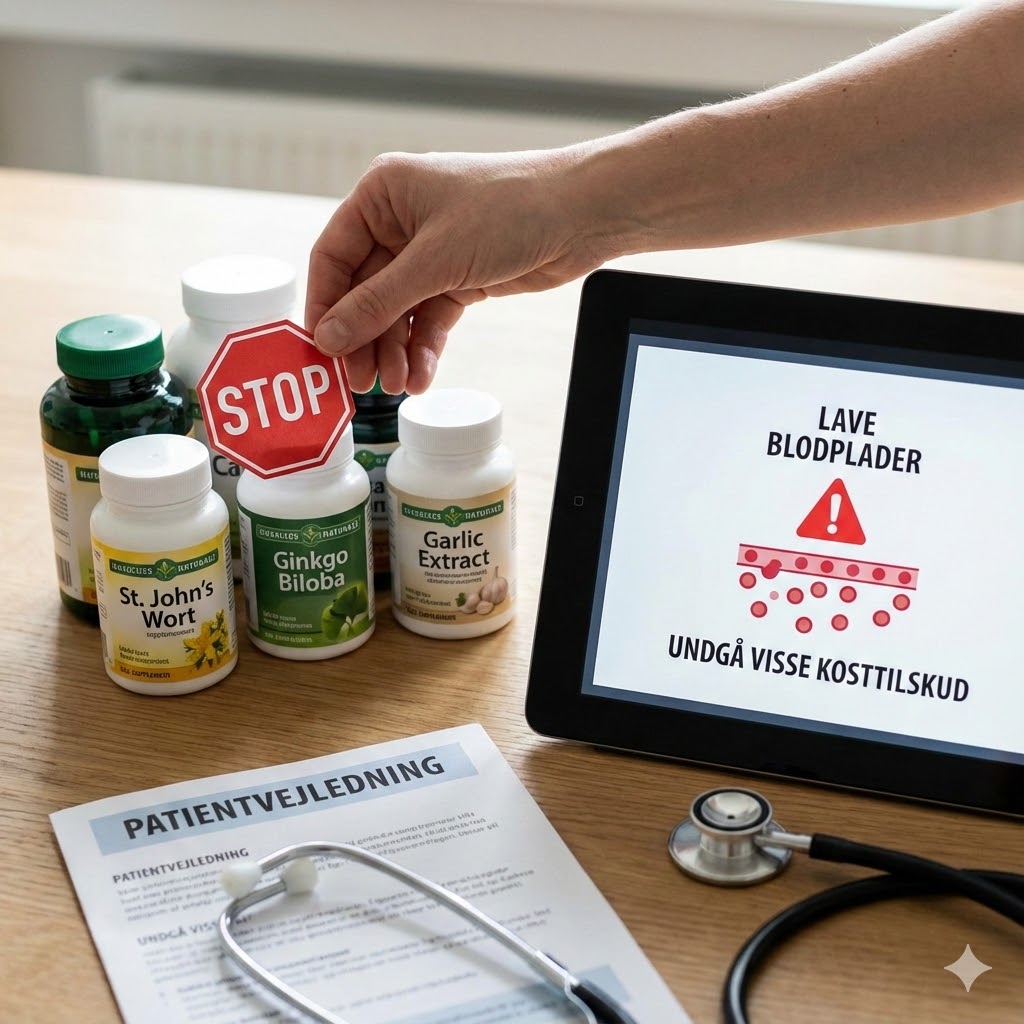
Many of the substances that fight cancer effectively (especially in this protocol) also have blood-thinning effects. If chemotherapy has lowered your platelets (thrombocytes) to a critical level, you must be extra cautious.
What you should pause during low platelets
If your counts are at rock bottom, the following substances should be paused to avoid bleeding risk until the marrow has recovered:
- Fatty acids: Omega-3 / fish oil / flaxseed oil (Strongly blood-thinning), Cod liver oil, Flaxseed oil (Budwig), and Krill oil.
- Herbal extracts (high dose): Curcumin / turmeric, Ginger, garlic (in large doses / capsules), ginkgo biloba, and Ginseng. (Inhibits the platelets’ ability to clump together).
- Enzymes: Proteolytic enzymes such as Bromelain, Papain, and Serrapeptase (as these break down fibrin, which helps the blood to clot).
- Specific Antioxidants: Vitamin E, Resveratrol, Quercetin, and strong Green Tea extract (EGCG).
- Off-label medicine: Aspirin, Magnyl, or Hjertemagnyl (must be stopped immediately with low platelets, unless otherwise agreed with the doctor).
Support for the bone marrow
There are strategies that specifically support the formation of platelets without counteracting the treatment:
- Melatonin: Studies show that melatonin can protect the bone mar
- row against chemo damage (taken at bedtime).
- Papaya leaf extract: Known for potentially being able to increase the number of platelets.
- Chlorophyll: Green juices (spinach/kale) provide Vitamin K, which supports blood coagulation.
- Shark liver oil (alkylglycerols): Can stimulate the formation of white blood cells and platelets (should not be taken on the actual chemo days).
NB: You should always discuss your intake of supplements with your oncologist.
Metabolic attack on the pancreas

Pancreatic cancer is known for being extremely “hungry” metabolically. The COC protocol is therefore widely used for this group, primarily due to Metformin.
Several observational studies have shown that patients with pancreatic cancer who were already taking Metformin (for diabetes) lived longer than those who did not.
The protocol attempts to utilize this effect systematically by combining Metformin (energy blocking) with statins and Mebendazole to hit the tumor’s hard survival mechanisms.
Conclusion
The COC protocol should not be considered a miracle cure, and it is not approved by the Health Authority. But the fact is that it apparently has helped many people in an exceptional way.
On the page Holistic Doctors in DK – Overview, there are names of the doctors in Denmark who prescribe the COC protocol. If you choose a private consultation, check when booking that they are willing to prescribe these repurposed drugs. However, there are also a number of cancer patients who have success in getting their own doctor to prescribe the COC protocol.
It can furthermore be an advantage if you can supplement with Melatonin – high dose. (Read more about this interesting repurposed drug via the green link.)
Gemini gets the second-to-last word here (my comment in parentheses):
There is (as with virtually all complementary treatment) a need for more research to confirm its effectiveness. (And that is a need that must be assumed to be far in the future, as there is no economic interest in researching medications that can no longer be patented.)
The preliminary results, originating from patient cases from Care Oncology Clinic, however, show a doubled survival time for patients with stage 4 brain cancer.
See also Repurposed drugs and Chemo – How do they work – Interactions
See also The Decision
See also Cancer treatment based on the Mitochondrial stem cell connection
See also Repurposed Drugs
See also Alternative Treatments – Overview
See also Holistic doctors – Overview
See also No medicine – Plan B
Links
[1] Interactions (search for preparations) (Interaction Database, Danish Medicines Agency)
- Content: A database from the Danish Medicines Agency where one can check for potential interactions between various drugs and supplements. (Danish language)
[2] How to starve cancer (Jane McLellan’s website, no date)
- Content: A website describing strategies to starve cancer cells through diet and repurposed drugs.
[3] The unique catalytic properties of PSAT1 mediate metabolic adaptation to glutamine blockade (Nature Metabolism, 2024)
- Content: A scientific article describing how metabolic adaptations in cells can be influenced. This is a non-randomized preclinical study.
[4] Forskes der i COC protokollen i Danmark, eller vil I? (Brain Tumor Association, 2021)
- Content: An article from the Brain Tumor Association highlighting the status of research into the COC protocol in Denmark. (Danish language)
[5] HCA HealthCare UK – Leaders in Oncology Care (Website, 2026)
[6] Forskere finder trick til at sulte kræftceller ihjel (Illustrated Science, 2024)
- Content: A popular science article about new methods to target the metabolism of cancer cells. (Danish language)
[7] Hvorfor vil læger ikke hjælpe ”dødsdømte”? (Health Policy Journal, 2021)
- Content: A debate article about doctors’ willingness to use experimental or off-label treatment for terminal patients. (Danish language)
[8] FOOKID (The association’s website)
[9] Targeting cancer metabolic pathways for improving chemotherapy and immunotherapy (PubMed, 2023)
- Content: A scientific review of strategies to target metabolic pathways to improve the effectiveness of chemotherapy and immunotherapy. This is a non-randomized review.
A New Method for Ethical and Efficient Evidence Generation for Off-Label Medication Use in Oncology(A Case Study in Glioblastoma) Updated (Frontiers)[10] A New Method for Ethical and Efficient Evidence Generation for Off-Label Medication Use in Oncology (A Case Study in Glioblastoma) Updated (Frontiers, 2019)
- Content: A study proposing new methods for collecting evidence for off-label drug use in oncology, based on patient cases with glioblastoma. This is a non-randomized case study.
Page created: July 3, 2024, Last revised October 26, 2024
❤
What you read on Jeg har Kræft is not a recommendation. Seek competent guidance.
