


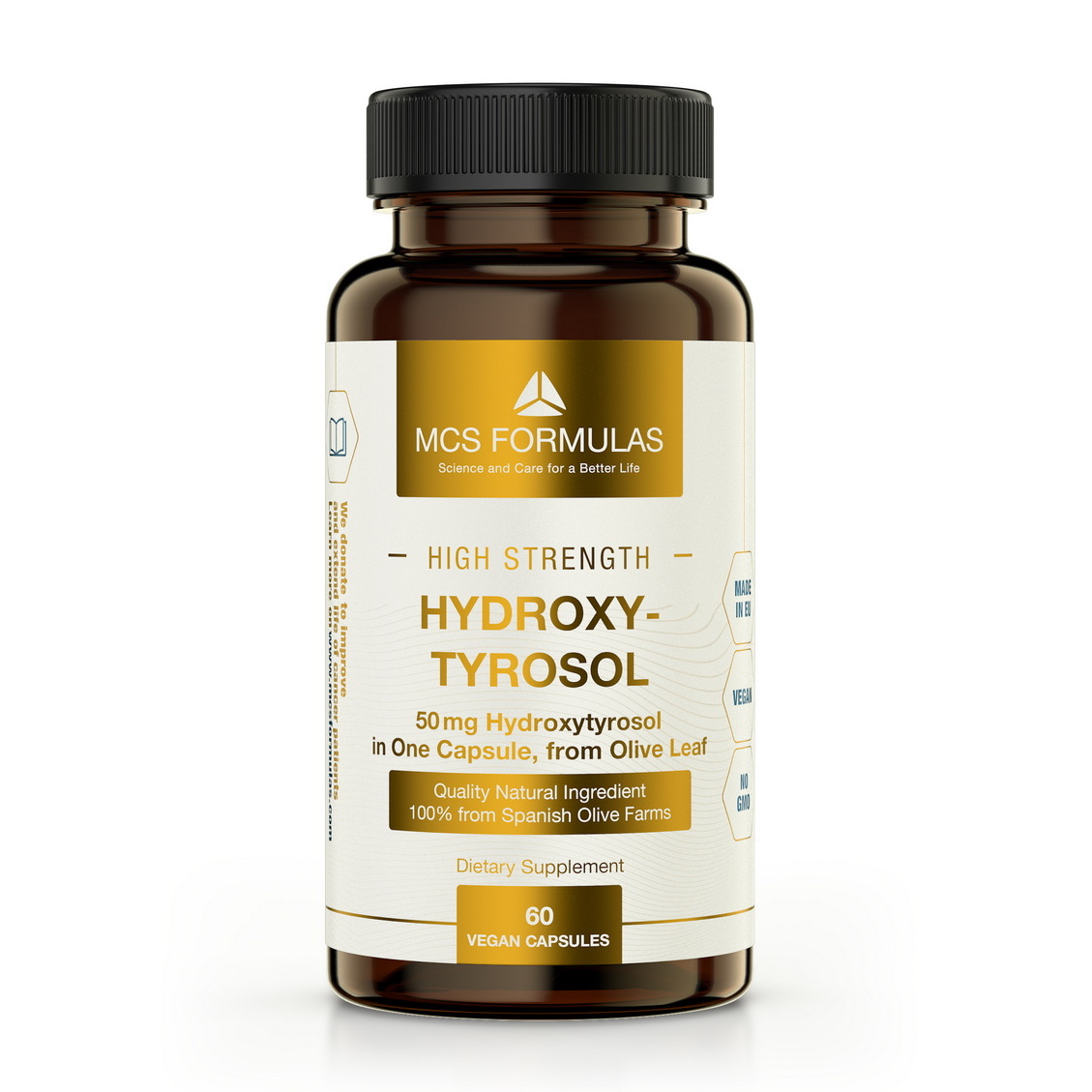
Hydroxytyrosol and cancer
What is Hydroxytyrosol
Hydroxytyrosol is a phenolic compound (plant-based chemical antioxidant) found naturally in olives, especially in olive oil and olive leaves. It is a powerful antioxidant with a wide range of potential health benefits. Hydroxytyrosol is one of the most potent natural antioxidants known and has gained significant interest in the research world due to its potential health-promoting properties. Chemically, it is a dihydroxyphenyl ethanol and belongs to the group of polyphenols known for their biological activities.
Historical
Historically, olives and olive oil have been used for thousands of years in the Mediterranean region, both as a food and in traditional medicine. Olive oil’s health-promoting properties are often attributed to its high content of hydroxytyrosol. Traditionally, olive leaves have also been used to make tea, believed to offer various health benefits.
Mechanisms of action and potential of hydroxytyrosol
Hydroxytyrosol has been shown to possess several mechanisms of action that may be relevant in relation to cancer:
Antioxidant effect
Hydroxytyrosol fights free radicals by donating electrons, rendering them stable and harmless. This protects cells from DNA damage, lipid peroxidation, and other forms of cellular damage that can contribute to cancer development [2, 4]. Hydroxytyrosol’s effectiveness as an antioxidant has been compared to other known antioxidants and has proven to be particularly potent.
Anti-inflammatory effect
Hydroxytyrosol can reduce inflammation by affecting various signaling pathways involved in inflammation. It can inhibit the production of pro-inflammatory enzymes (COX-2) and cytokines (TNF-α, IL-6), which play a central role in inflammatory processes [1]. By dampening inflammation, hydroxytyrosol could potentially contribute to preventing the development of chronic diseases, including cancer.
Influence on cell cycle and apoptosis
Hydroxytyrosol can potentially stop cancer cells from dividing by affecting various phases of the cell cycle. It can also promote apoptosis, a programmed cell death essential for removing damaged or abnormal cells, including cancer cells [2, 4]. This dual effect on the cell cycle and apoptosis makes hydroxytyrosol particularly interesting in cancer treatment research.
Inhibition of angiogenesis
Hydroxytyrosol may inhibit the formation of new blood vessels by influencing factors that promote angiogenesis. This can limit the nutrient supply to cancer cells and thus inhibit their growth and spread. Angiogenesis is a crucial process for tumors as it ensures oxygen and nutrients. By inhibiting angiogenesis, one can starve the tumor and prevent it from growing and spreading.
Modulation of the immune system
Hydroxytyrosol can potentially strengthen the immune system by increasing the activity of certain immune cells (e.g., NK cells) and promoting the production of antibodies. The immune system plays an important role in fighting cancer, and by modulating the immune response, hydroxytyrosol could potentially contribute to improving immune surveillance and the elimination of cancer cells.
Clinical studies
A range of clinical studies have investigated hydroxytyrosol’s potential in relation to cancer, but results are still limited, and more research is needed:
- Some studies suggest that hydroxytyrosol can have a positive effect on certain markers for cancer, but there are also studies that have shown no significant effect.
- These are primarily smaller studies, and results must be confirmed in larger and better-designed clinical trials [3].
- Research is still in an early stage, and more comprehensive clinical studies are needed to establish hydroxytyrosol’s precise role in cancer treatment.
Note
- Most studies focus on hydroxytyrosol’s effect in areas other than cancer, such as cardiovascular health.
There is limited research specifically on hydroxytyrosol and cancer, and more clinical human studies are required.
Safety
Hydroxytyrosol is generally considered safe in moderate doses. However, there is limited knowledge about the safety of high doses and long-term use.
Advantages of hydroxytyrosol
- Powerful antioxidant effect
- Anti-inflammatory effect
- Potentially influences the cell cycle and promotes apoptosis
- Potentially inhibits angiogenesis
- Potentially modulates the immune system
Disadvantages and limitations
- Limited research specifically on hydroxytyrosol and cancer
- Clinical study results are limited
- Safety at high doses and long-term use is not fully investigated
- The effect of hydroxytyrosol may vary depending on the individual’s health status and other factors.
Dispensing and application
Dietary supplements
Hydroxytyrosol is available as a dietary supplement in the form of capsules or tablets.
Olive oil
Extra virgin olive oil is a good source of hydroxytyrosol.
Dosage
The recommended dose varies depending on the product and the individual situation. It is a good idea to follow the instructions on the product and speak with your practitioner if in doubt.
Conclusion
Hydroxytyrosol is a powerful antioxidant with several interesting mechanisms of action potentially relevant to cancer [1, 6]. However, more research, especially clinical human studies, is needed to clarify the precise mechanisms of action and the potential for hydroxytyrosol as a supplementary treatment for cancer.
It is always a good idea to talk to your practitioner before taking hydroxytyrosol as a dietary supplement, especially if you are in treatment for cancer or taking other medication.
Back to Dietary supplements
Links
[1] Anti-Inflammatory and Antitumor Effects of Hydroxytyrosol but Not Oleuropein on Experimental Glioma In Vivo. A Putative Role for the Renin-Angiotensin System (PubMed, 2018)
- Content: A study documenting that hydroxytyrosol reduces tumor growth and inflammation in an animal model of brain cancer.
[2] Hydroxytyrosol induces apoptosis in human colon cancer cells through ROS generation (Food and Function, 2014)
- Content: An in vitro study showing how hydroxytyrosol induces programmed cell death in colon cancer cells by generating oxidative stress.
[3] Hydroxytyrosol, a Component of Olive Oil for Breast Cancer Prevention in Women at High Risk of Cancer (PubMed, 2025)
- Content: A clinical study investigating the role of hydroxytyrosol in preventing breast cancer in high-risk women.
[4] A Novel Synthesized Cyclohexane-Hydroxytyrosol Derivative Suppresses Ovarian Cancer Cell Growth Through Inducing Reactive Oxidative Species and Blocking Autophagic Flux (PubMed, 2024)
- Content: Research on a hydroxytyrosol derivative that inhibits ovarian cancer cell growth by inducing cell death.
[5] Biosynthesis and Biotechnological Synthesis of Hydroxytyrosol (PubMed, 2024)
- Content: Scientific review of the methods for producing hydroxytyrosol and its biological activities.
[6] Unlocking the effective alliance of β-lapachone and hydroxytyrosol against triple-negative breast cancer cells (PubMed, 2024)
- Content: A study exploring the synergy between hydroxytyrosol and other compounds in fighting aggressive breast cancer cells.
Page created: Feb 01, 2025.
❤
What you read on Jeg har Kræft is not a recommendation. Seek competent guidance.
