


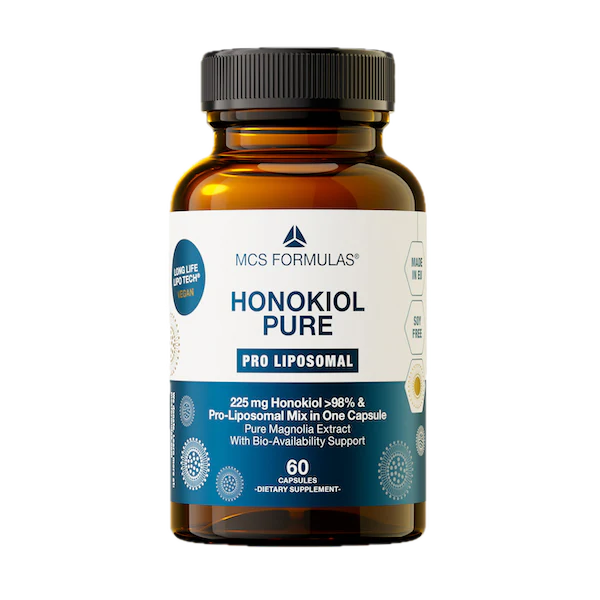
Honokiol and cancer
Summary of Honokiol
Effect:
- Honokiol is a bioactive substance from the Magnolia tree that effectively passes through cell membranes and the blood-brain barrier.
- It has powerful antioxidant and anti-inflammatory effects and disrupts survival signals in cancer cells.
Potential in cancer:
- The substance shows significant potential by inducing cell death (apoptosis), inhibiting the formation of new blood vessels for tumors, and targeting resistant cancer stem cells.
- It is particularly relevant for brain cancer and as a support to counteract resistance to chemotherapy.
Main limitation:
- It is fat-soluble and difficult for the body to absorb unless taken in a liposomal form or with fats.
What is Honokiol
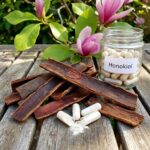
Honokiol is a lignan isolated from the bark, seed capsules, and leaves of trees in the Magnolia genus, primarily Magnolia officinalis. It is a small molecule with a structure that allows it to pass through cell membranes easily. One of its most unique properties is the ability to cross the blood-brain barrier, making it a rare and valuable tool for treating conditions of the central nervous system. It is considered a pleiotropic compound, meaning it can influence many different biological processes in the body simultaneously.
History
Honokiol comes from traditional Asian medicine, where Magnolia bark, known as “Hou Po,” has been used for thousands of years. In China and Japan, it was originally used for disorders characterized by “stagnated energy,” such as anxiety, digestive issues, and asthma. Only in recent times has Western research isolated the molecule and mapped its broad-spectrum properties in oncology.
Mechanisms of action
Honokiol exerts its effect by modulating a wide range of proteins and signaling pathways at the cellular level. This multifunctional approach makes it difficult for cancer cells to develop resistance, as they are attacked from multiple angles simultaneously.
Promoting cell death
A central mechanism is the activation of pro-apoptotic factors. Apoptosis is a natural process where damaged cells commit suicide, but cancer cells often deactivate this function.
Honokiol restarts the process by affecting the mitochondria and triggering the release of enzymes (caspases) that break down the cancer cell from the inside.
Recent studies also show that the substance can activate ferroptosis, an iron-dependent form of cell death, which is an important mechanism for targeting resistant cancer cells in the brain.
Inhibition of growth signals
The substance blocks several signaling pathways that cancer cells use for aggressive division. This specifically includes the inhibition of NF-kB, a protein complex that controls DNA transcription and promotes inflammation and survival.
By dampening NF-kB, both the growth rate and the inflammatory environment around the tumor are reduced. Additionally, the mTOR and STAT3 signaling pathways, which are crucial for cancer cell energy metabolism and growth, are inhibited.
Angiogenesis
To grow larger than a few millimeters, a tumor must form its own blood vessel system. Honokiol has shown the ability to inhibit VEGF (Vascular Endothelial Growth Factor), the signaling substance tumors release to attract new blood vessels. Without this supply, the tumor is starved and its growth is limited.
Extraordinary antioxidant strength
In addition to direct cancer-inhibiting mechanisms, Honokiol acts as an extremely potent antioxidant in healthy cells. Studies have shown it can be up to 1000 times stronger than Vitamin E in protecting cells from oxidative stress.
This immense strength means it not only attacks cancer cells but also serves as an effective shield for healthy tissue against damage that can lead to disease development.
Potential in cancer
There is great interest in Honokiol because it can target cancer cells broadly without showing the same toxicity to healthy cells as many conventional agents.
Brain cancer and metastases
Because Honokiol effectively crosses the blood-brain barrier, it has particular potential for glioblastoma and other primary brain tumors, as well as metastases in the brain.
Many chemotherapy drugs are stopped by this barrier, but Honokiol can penetrate and act directly in the brain tissue, a rare property among cancer-inhibiting substances.
Combating cancer stem cells
Research indicates that Honokiol can target cancer stem cells. These cells are often the cause of recurrence and metastasis because they survive standard treatment.
By blocking signaling pathways like Notch and Wnt, which are active in stem cells, Honokiol can potentially help prevent the disease from returning.
Synergy with conventional treatment
Honokiol appears to sensitize (increase the sensitivity of) cancer cells to chemotherapy and radiation. By breaking down the cells’ defense mechanisms, the effect of conventional medicine can theoretically be increased, while Honokiol’s antioxidant effect can protect healthy tissue from treatment damage. Additionally, recent data indicates that the substance can suppress PD-L1, making cancer cells more visible to the immune system and potentially improving the effect of immunotherapy.
Advantages of Honokiol
A notable advantage of Honokiol is its dual effect on both body and mind. Beyond its cancer-inhibiting properties, it acts as an anxiolytic and sleep aid by affecting GABA receptors in the brain.
This provides significant support for people in cancer treatment, where stress and insomnia are frequent challenges. Its natural origin and generally mild side effect profile make it an attractive supplement for quality of life.
Disadvantages and limitations
The primary challenge is the substance’s low bioavailability. It is strongly hydrophobic (water-repellent), meaning the body has difficulty absorbing it from the gut if taken as a pure powder.
It requires ingestion with fat or a specialized composition/processing.
Furthermore, it has a relatively short half-life in the blood, which may necessitate frequent dosing to maintain a stable concentration.
Clinical studies

An extensive amount of preclinical research exists in vitro (in test tubes) and in vivo (in living organisms), documenting effects across cancer types such as lung, breast, prostate, and colon cancer, as well as leukemia.
While results from animal models are consistent and positive, large randomized human trials are still needed to finally determine clinical dosages.
Most data are thus based on laboratory experiments.
Safety

Honokiol is generally considered safe. At high doses, drowsiness may occur due to the effect on the nervous system. An inhibitory effect on blood platelet aggregation has been observed, meaning the substance has blood-thinning properties.
Therefore, caution is necessary if taking blood-thinning medication or undergoing surgery.
Pregnant and breastfeeding women should avoid the substance due to a lack of safety data.
Dispensing and application
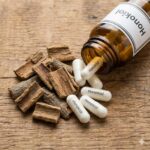
To ensure optimal absorption and effect, the following should be observed:
- Always take capsules with a high-fat meal or a little oil (e.g., olive oil), as the substance is fat-soluble.
- Prefer liposomal products if possible, as these significantly increase absorption.
- Since the substance can be calming, it may be beneficial to take part of the dose in the evening.
- Start low and increase slowly to monitor the body’s reaction.
Strategic placement and combination

In a treatment protocol, Honokiol has a versatile role, but its primary function is offensive.
Type: Kill (bomb)
Honokiol is categorized as Kill (bomb). This is due to its direct ability to induce apoptosis and block vital survival pathways in cancer cells. It attacks the tumor tissue itself and its blood supply (angiogenesis). While it has supportive properties against stress, its attack on the cancer cell defines its strategic placement.
Synergy
- Modified Citrus Pectin (MCP): Can be a useful supplement, as Honokiol attacks the cell and induces death, while MCP blocks metastasis via binding proteins (Galectin-3).
- Curcumin: Often acts synergistically with Honokiol regarding downregulation of inflammation and inhibition of the NF-kB signaling pathway.
- Chemotherapy: Studies have shown that Honokiol can increase the effect of drugs like Cisplatin and Doxorubicin by making cancer cells more susceptible.
Avoid simultaneous intake
- Blood-thinning medication: Due to the antiplatelet effect, the dose should be adjusted in consultation with a practitioner to avoid bleeding risks.
- Alcohol and sleep medication: The calming effect can be amplified by simultaneous intake of other sedatives.
- Strong antioxidants during chemo: Although Honokiol is an antioxidant, high-dose antioxidants should generally be avoided near chemotherapy treatment unless otherwise agreed with a doctor.
Conclusion

Honokiol appears to be a potent, plant-based option in complementary cancer treatment. With its rare ability to cross the blood-brain barrier and its multiple points of attack on cancer cell biology, it offers a broad-spectrum effort. It is particularly relevant for patients wanting to target cancer stem cells and dampen bodily unrest. As with all powerful natural medicine, respect for dosage and awareness of interactions is required. The substance’s broad action profile positions it as a promising candidate for the next generation of plant-based pharmaceuticals.
Find more Quizzes here
Back to Dietary supplements
Thanks for the tip
To Pia Friis (from the Facebookgroup Jeg har Kræft – Hvad kan jeg gøre)
Links
[1] Honokiol: A Review of Its Anticancer Potential and Mechanisms (MDPI, 2020)
- Content: A review article examining the molecular mechanisms through which Honokiol exerts its effect against various cancer types, including signal pathway regulation.
[2] Comprehensive Computational Analysis of Honokiol Targets (NIH/PubMed Central, 2022)
- Content: A study investigating Honokiol’s ability to target breast cancer stem cells (BCSC). Results indicate the substance can counteract chemoresistance and metastasis.
[3] Honokiol Eliminates Glioma/Glioblastoma Stem Cell-Like Cells Via JAK-STAT3 Signaling and Inhibits Tumor Progression by Targeting Epidermal Growth Factor Receptor (NIH/PubMed Central, 2018)
- Content: The study shows how Honokiol inhibits glioblastoma growth by blocking the EGFR growth receptor and targeting the stem cells that often cause recurrence.
[4] Synergistic antitumor effects of liposomal honokiol and cisplatin (NIH/PubMed Central, 2011)
- Content: An in vivo study documenting that the combination of liposomal Honokiol and the chemotherapy Cisplatin works significantly better against ovarian cancer than the agents individually.
[5] Honokiol traverses the blood-brain barrier and induces apoptotic insults to neuroblastoma cells (National Institutes of Health (NIH), 2012)
- Content: Confirms the substance’s ability to pass into the brain and initiate cell death in nervous system cancer cells.
[6] Revealing the role of honokiol in human glioma cells (ScienceDirect, 2024)
- Content: The study investigates the mechanism behind Honokiol’s action in brain cancer cells and finds it can trigger ferroptosis via the MAPK pathway.
[7] Honokiol as a next-generation phytotherapeutic (ScienceDirect, 2025)
- Content: A scientific review of Honokiol’s potential as a pharmaceutical, describing its broad action against cancer growth, angiogenesis, and metastasis.
[8] Honokiol suppress the PD-L1 expression to improve anti-tumor immunity in lung cancer (NIH/PubMed, 2024)
- Content: A study documenting how Honokiol degrades the PD-L1 protein on lung cancer cells, potentially improving anti-tumor immunity.
[9] Magnolol and honokiol isolated from Magnolia officinalis protect rat heart mitochondria against lipid peroxidation (NIH/PubMed, 1994)
- Content: A study documenting that the antioxidant effects of Honokiol are significantly higher than vitamin E.
[10] Targeting galectin-3 in inflammatory and fibrotic diseases (ScienceDirect, 2023)
- Content: A study documenting how the binding protein Galectin-3 is a key player in inflammation and fibrosis.
Page created: Jan 07, 2026. Last revised: Apr 29, 2026.
❤
What you read on Jeg har Kræft is not a recommendation. Seek competent guidance.
