


Dr. Rath’s Protocol
Summary of Rath’s Protocol
Purpose:
- To stop cancer’s ability to spread (metastasize). The protocol does not attack the tumor itself with poison, but attempts to make the body’s connective tissue impenetrable, so that the cancer is “encapsulated” and isolated.
Content:
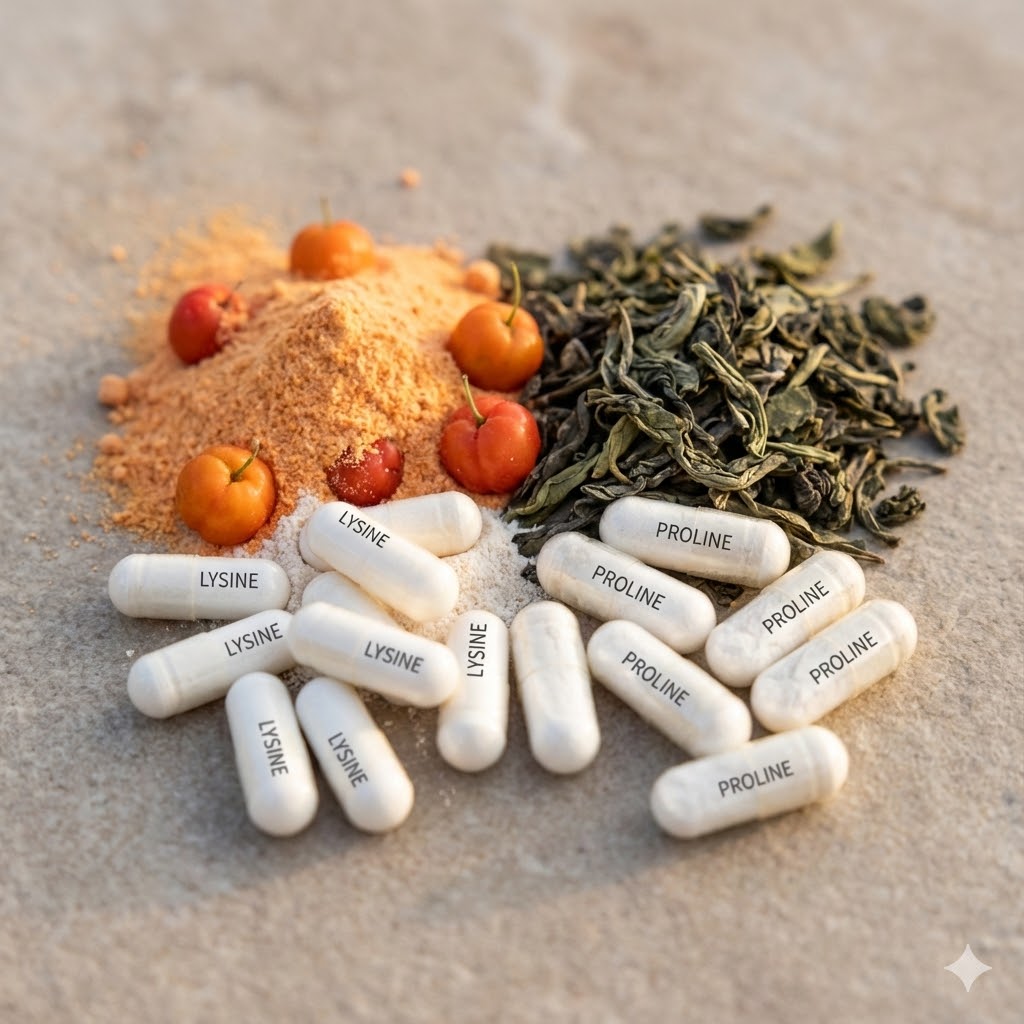
- High-dose supplements of the body’s own building blocks for collagen: Vitamin C, L-Lysine, L-Proline, and Green tea extract (EGCG).
The central idea:
- For a cancer cell to move, it must dissolve the surrounding tissue. By blocking the “scissors” (enzymes) that cancer uses, and simultaneously strengthening the tissue, the disease is locked in place.
Who is Dr. Matthias Rath

Dr. Matthias Rath is a German doctor and researcher who, in the late 1980s, worked closely with the double Nobel Prize winner Linus Pauling (the founder of orthomolecular medicine and a great advocate for Vitamin C). Together they developed the concept of “Cellular Medicine”.
Rath is a controversial figure, primarily because he has aggressively challenged the pharmaceutical industry with the claim that chronic diseases (including cancer and cardiovascular diseases) are primarily due to long-term deficiency of micronutrients.
Where modern oncology focuses on killing the cancer cell, Rath focuses on strengthening the “prison” (connective tissue) that keeps the cancer cell trapped.
Collagen as a defense

To understand the protocol, one must understand how metastases occur. This is where Rath differs from almost everyone else.
1. The problem: MMP enzymes
The biological scissors
Cancer cells are not dangerous as long as they stay where they are. The danger arises when they spread. For a cancer cell to move through the body, it secretes large amounts of enzymes called matrix metalloproteinases (MMPs).
These enzymes act as chemical scissors that cut the body’s connective tissue (collagen) into pieces, so the cancer cell can “gnaw” its way into the bloodstream and further to other organs.
The more aggressive the cancer, the more MMP enzymes it produces [1].
2. The solution: Lysine, Proline and Vitamin C
The mortar
To understand the solution, one must look at the body’s “armoring.” Our connective tissue consists primarily of the substance collagen. These are the strong fibers that hold our cells, organs, and skin together. Without strong collagen, the body’s tissue loses its coherence and stability (which was the underlying cause of the symptoms in scurvy, where connective tissue became fragile and unstable).
Rath’s point is that cancer patients often suffer from “chronic scurvy” at the cellular level – their connective tissue is too weak to resist cancer’s attack.
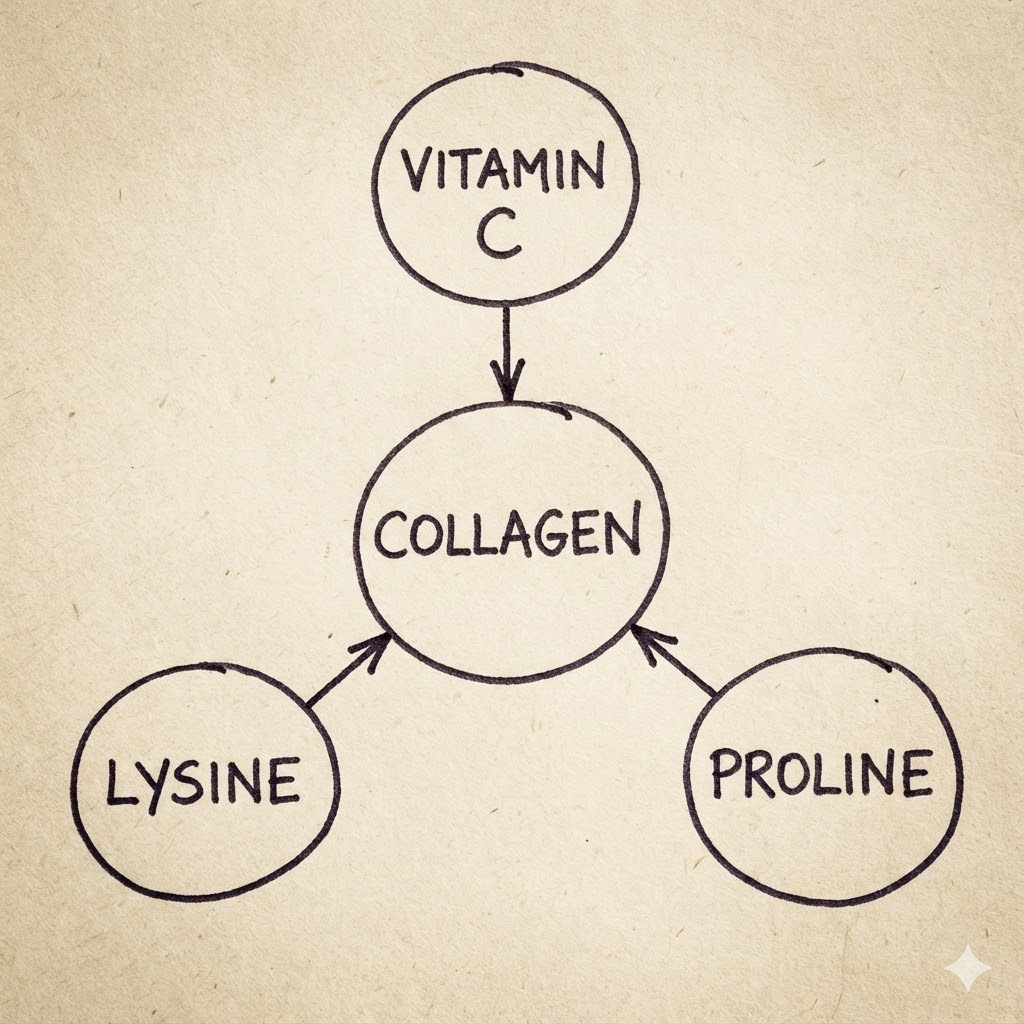
To build an impenetrable wall around the tumor, one must add three specific components in large amounts:
Lysine (the bricks):
- This is an essential amino acid. This means that your body cannot produce it itself. You are 100% dependent on getting it through your diet. Lysine acts as the anchors that hold the collagen fibers in place.
- Without enough Lysine, the connective tissue becomes loose and permeable, so cancer cells can easily push through.
L-Proline (the reinforcement):
- This is another amino acid that is the main component in collagen. The body can produce a little proline itself, but not nearly enough when it is under attack from a disease like cancer.
- Therefore, it is called “conditionally essential.”
- By adding extra Proline, one ensures that the body never runs out of building material for repair.
Vitamin C (the hardener):
- This is the key that brings it all together. Vitamin C acts as the “glue” that weaves lysine and proline together into strong, tough ropes or mats (collagen fibers). Without large amounts of Vitamin C, the body simply cannot bind the amino acids together, and the connective tissue remains soft and unstable.
The result:
- When one “floods” the body with these three substances simultaneously, there is a marked strengthening of the connective tissue. It is equivalent to going from building with mud to building with reinforced concrete.
- The result is that the tissue surrounding the tumor becomes so dense and strong that cancer’s enzymes (the scissors) cannot cut through. The disease becomes “walled in” [2].
3. The blocking: EGCG
The lock
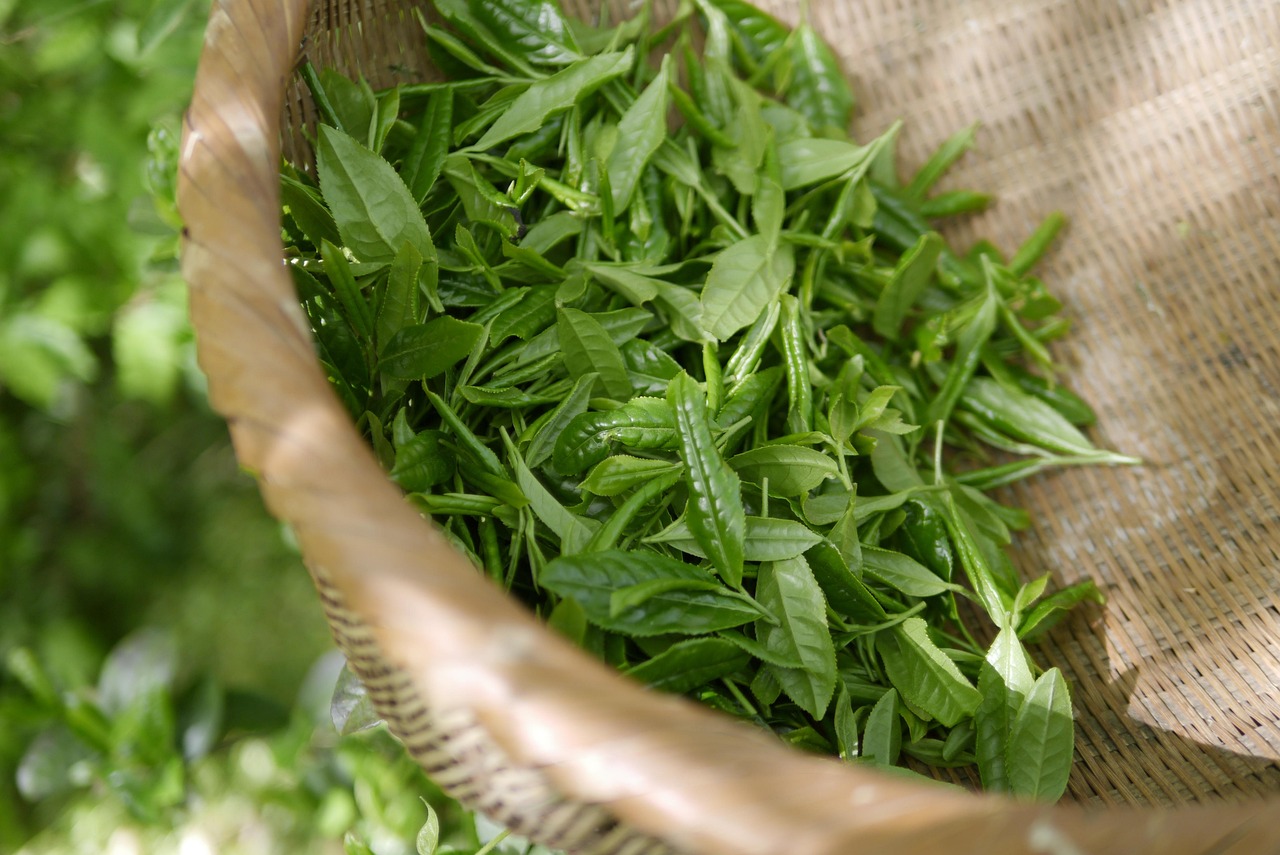
Later research from Rath’s institute showed that the addition of EGCG (from green tea) creates a synergistic effect. EGCG has the ability to directly inhibit the activity of MMP enzymes (matrix metalloproteinases).
Thus, the scissors are removed from the cancer cell while the wall is reinforced [3].
The protocol in practice
Since Dr. Rath’s own products can be expensive and difficult to import, many choose to compile the protocol themselves using generic (similar) supplements. This is often cheaper and allows for precise adjustment of doses.
The challenge is the quantities. Since one needs to reach many grams daily, it is almost impossible to do with regular capsules (one would have to swallow 20-30 per day). The solution is to buy the ingredients as pure powder.
1. What you should be aware of
To follow the protocol correctly, you must acquire the following four components. Pay attention to the declaration on the packaging:
- Vitamin C (powder): Avoid pure ascorbic acid if you have a sensitive stomach, as it is very acidic in large amounts. Go for calcium ascorbate or sodium ascorbate. These are acid-neutral (pH-neutral) and much easier for the stomach to tolerate in high doses.
- L-Lysine (powder): Often bought in sports stores (used by bodybuilders). Make sure it is pure L-Lysine HCL without added flavor or sweetener.
- L-Proline (powder): Also an amino acid. May be harder to find in physical stores than Lysine, but is easily available online. Must be pure L-Proline powder.
- Green tea extract (capsules): Here, powder rarely works due to the bitter taste. Buy capsules.
The most important thing is the concentration of the active substance EGCG. Check the label: It must state standardized to min. 45% or 50% EGCG.
If it only says “green tea powder,” the content of the active substance is too low.
2. How to mix the “Cell Drink”
Instead of eating pills all day, the daily ration of powder is mixed in a jug with water or juice, which is drunk continuously, or divided into three glasses.
Basic mixture (daily ration):
- 6 grams Vitamin C powder (approx. 1.5 teaspoons – depending on bulk density, use a digital scale the first time).
- 4 grams L-Lysine powder (approx. 1 teaspoon).
- 2 grams L-Proline powder (approx. 0.5 teaspoon).
Mix the powders in 1 liter of water (possibly with a little sugar-free juice for taste) and store it in the refrigerator.
3. Important start and adjustment
One must never start on a full dose of Vitamin C from day 1. It will result in stomach cramps and diarrhea, as the gut needs to get used to absorbing the large amounts.
- Week 1: Start with half the dose of Vitamin C (3 grams daily) spread throughout the day. Lysine and Proline rarely cause stomach problems and can be taken in full from the start.
- Week 2: Gradually increase the Vitamin C. If you get loose stools, lower the dose a bit again. This is called the “bowel tolerance limit.” This is where the body is saturated. For cancer patients, this limit is often very high (10-20 grams) according to Rath, as a sick body absorbs Vitamin C.
4. A day on the protocol
The goal is to maintain a constant level of substances in the blood, so that the connective tissue is constantly repaired. Detailed breakdown at the bottom of the page.
What does the science say
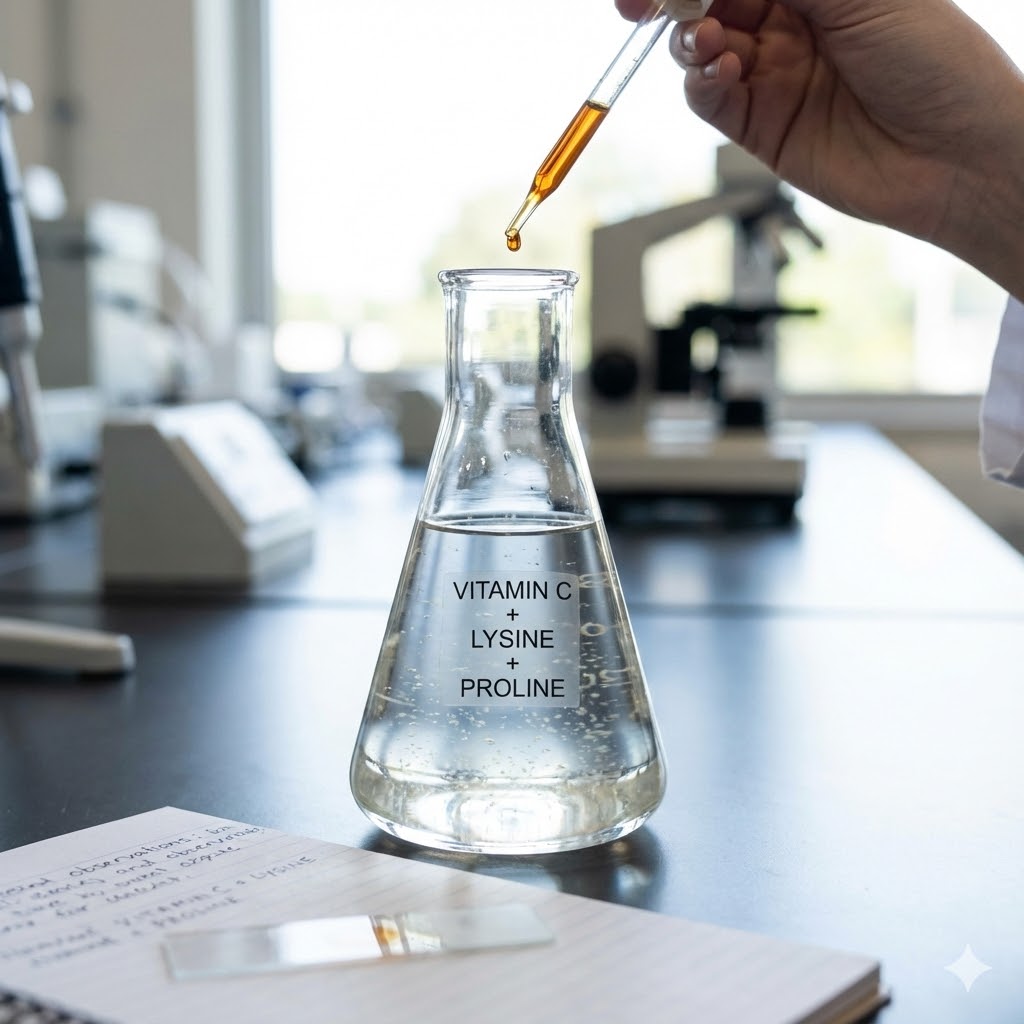
Rath’s research institute (Dr. Rath Research Institute in California) has published a long series of in-vitro (test tube) and in-vivo (animal) studies.
Results
Their studies consistently show that the combination of nutrients (“Nutrient Synergy”) is much more effective than the substances individually.
In certain experiments with cancer cell lines (breast, lung, colon, melanoma), they have demonstrated significant inhibition of cancer cell invasion (spread) through a collagen matrix [4].
Criticism
The conventional medical system acknowledges the mechanisms (that MMPs control metastases), but criticizes the lack of large, double-blind clinical trials on humans (phase 3 studies) that prove it works in a living patient over time.
One can only wonder why no one has chosen to sponsor such studies…
Important warnings

Although amino acids and vitamins are natural substances, they can create imbalances in certain patient groups when taken in large doses.
Kidney stones (oxalates)
Vitamin C is partially broken down into oxalate in the body, which must be excreted through the kidneys.
The problem:
- If you tend to have kidney stones (calcium oxalate stones) or reduced kidney function, high doses of Vitamin C (over 1-2 grams daily) can significantly increase the risk of stone formation.
- It is important to drink large amounts of water and possibly have your kidney function measured.
Iron accumulation
Vitamin C greatly increases the absorption of iron from the diet.
The problem:
- If you suffer from hemochromatosis (a hereditary disease where iron accumulates in the organs – rare), high doses of Vitamin C can be dangerous, as it can lead to iron poisoning of the liver and heart.
- Have your iron status (ferritin) checked by a doctor.
Chemo interaction
Rath’s protocol is based on antioxidants.
The problem:
- Some forms of chemotherapy and radiation therapy work by creating “oxidative stress” (free radicals) to kill cancer cells. If you take high doses of antioxidants (Vitamin C and EGCG) at the same time, you could theoretically “protect” the cancer cell from the treatment.
- It is often recommended to take a break from high-dose antioxidants 2-3 days before and after chemo (depending on the type). Always ask your oncologist.
Also see Antioxidants – for and against
Safety
Always consult your healthcare provider before starting a protocol.
Conclusion
Rath’s Protocol is not a “magic cure” that promises to dissolve a tumor in a week. It is a structural treatment method. It is aimed at the patient who understands that cancer is a process, and who has a desire to change the body’s “architecture” with the aim of making it difficult for the disease to thrive.
The method is particularly relevant as a supplement to prevent recurrence or spread after surgery, or to slow metastases in advanced disease. It can be combined with most other treatments, but one should always inform one’s oncologist when using high-dose antioxidants during chemotherapy.
A typical day on the protocol
The goal is to maintain a constant concentration of the active substances in the blood around the clock, so that the connective tissue is constantly repaired (“walled up”). The half-life of Vitamin C and Lysine is short, so doses must be distributed precisely.
Morning (building)
- Dose: 1,000 mg Vitamin C + 1,000 mg L-Lysine + 500 mg L-Proline.
- Blocking: 1 capsule Green Tea Extract (approx. 300-400 mg EGCG) + Multivitamin (for copper/manganese).
- Timing: Preferably taken 15-30 minutes before breakfast for maximum absorption. If the stomach has difficulty handling it (stomach pain), take them in the middle of the meal.
Lunch (maintenance)
- Dose: 1,000 mg Vitamin C + 1,000 mg L-Lysine + 500 mg L-Proline.
- Blocking: 1 capsule Green Tea Extract.
- Function: This dose ensures that the level of Lysine and Vitamin C does not drop during the afternoon, where many otherwise experience a “gap” in coverage.
Evening (nightly repair)
- Dose: 1,000 mg Vitamin C + 1,000 mg L-Lysine + 500 mg L-Proline.
- Blocking: 1 capsule Green Tea Extract.
- Function: Since the body primarily repairs tissue and forms collagen while you sleep, the evening dose is crucial for the night’s rebuilding of connective tissue around the tumor.
Note on purchasing: You can choose to buy the ingredients as loose powder (cheapest) and mix in water, or as capsules (most precise).
If you use powder, 1,000 mg is approximately ¼ teaspoon, but use a digital scale at first.
Also see Stress management
Also see Bill Henderson Protocol
Links
[1] Matrix Metalloproteinases Inhibitors in Cancer Treatment: An Updated Review (2013–2023) (MoleculesMDPI, 2023)
- Content: A scientific review confirming that MMP enzymes play a major role in cancer spread by breaking down the extracellular matrix (connective tissue). The article supports the strategy of inhibiting these enzymes to stop metastases, which is the core of Rath’s protocol.
[2] The dual role of vitamin C in cancer: from antioxidant prevention to prooxidant therapeutic applications (Frontiers in Nutrition, 2025)
- Content: A comprehensive study reviewing the biochemical functions of Vitamin C. Particularly relevant to the protocol is the documentation of how Vitamin C can downregulate Matrix Metalloproteinase 9 (MMP-9) and thus potentially inhibit metastases. It supports the thesis of Vitamin C as a structural component in cancer treatment.
[3] Targeting Cancer Hallmarks with Epigallocatechin Gallate (EGCG): Mechanistic Basis and Therapeutic Targets (MDPI / Molecules, 2024)
- Content: A study of the substance EGCG (from green tea) that specifically looks at its ability to interfere with signaling pathways in cancer cells. The conclusion supports that EGCG can attack the processes around invasion and metastasis, which validates the use of green tea as the “lock” in the protocol.
[4] Dr. Rath’s Biography, Health For All (Dr Rath Institute’s Website)
- Content: The institute’s own overview of their cancer research. Here you will find graphs and data showing the “Synergy Effect” – i.e., why it is necessary to take the substances together and not individually to achieve the “walling in” effect.
Page created: December 23, 2025
❤
What you read on “Jeg har Kræft” is not a recommendation. Seek competent guidance.
