


Overview of Complementary and Alternative Treatments

Grounding and cancer
Grounding summary
What it is:
- A practice that creates direct electrical contact with the earth’s surface to balance the body’s electrical charge. Physical contact with the ground supplies the body with free electrons, which act as natural antioxidants by neutralising free radicals.
Physiological effect:
- Randomised studies indicate that grounding increases the negative charge on red blood cells, improving blood viscosity and circulation.
Psychological grounding:
- Sensory techniques such as the 5-4-3-2-1 method are used to calm the nervous system during acute stress or anxiety.
Winter solutions:
- In freezing weather, conductive silver-thread socks, grounding mats, or contact with tree bark can maintain the connection without the risk of cold injury.
What is grounding

Grounding is an umbrella term for two very different complementary approaches, both aimed at regulating the body’s nervous system and biological balance. One branch is biophysical earthing, which focuses on the body’s direct electrical contact with the ground to equalise electrical potential. The other branch is psychological grounding, which uses cognitive and sensory techniques to bring an overstimulated mind back to the present. Although the methods differ, they both work towards the same goal: moving the body out of a chronic stress or inflammation state and back to homeostasis (internal balance).
Integration into the earth’s DC circuit
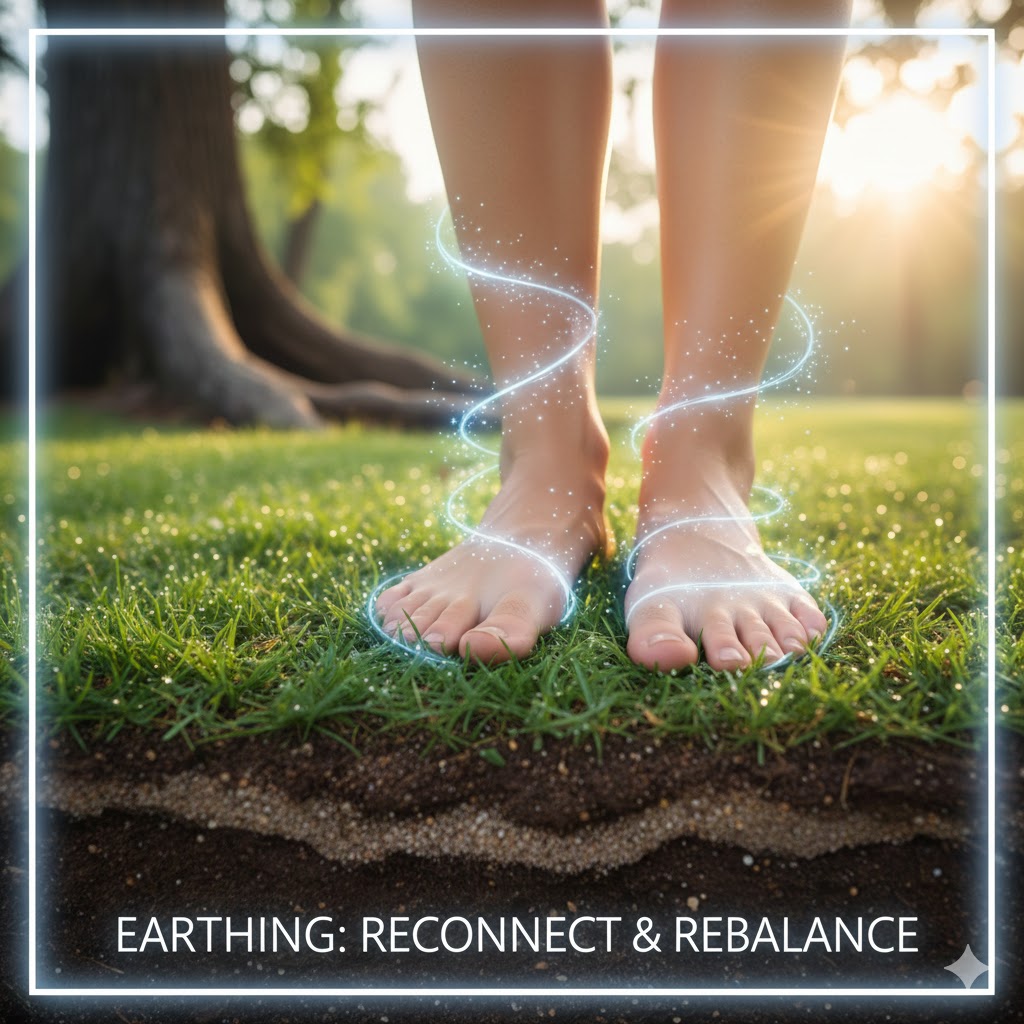
Physical earthing is based on the body’s conductivity and its interaction with the earth’s natural energy flow. According to the study Practical applications of grounding to support health [5], the earth operates via direct current – DC. Because the human body is highly conductive, fundamental processes such as heartbeat and brain activity function using this very bioelectrical energy.
When the body is insulated from the earth by rubber soles and synthetic floors, a positive static charge accumulates, which may correlate with chronic inflammation. A randomised, double-blind study [4] has shown through objective measurements that re-establishing this connection via grounding mats significantly extends sleep duration and improves recovery. This integration into the global circuit is believed to optimise the body’s natural ability to function and may play a preventive role against the development of disease.
Haemodynamic effect and inflammation
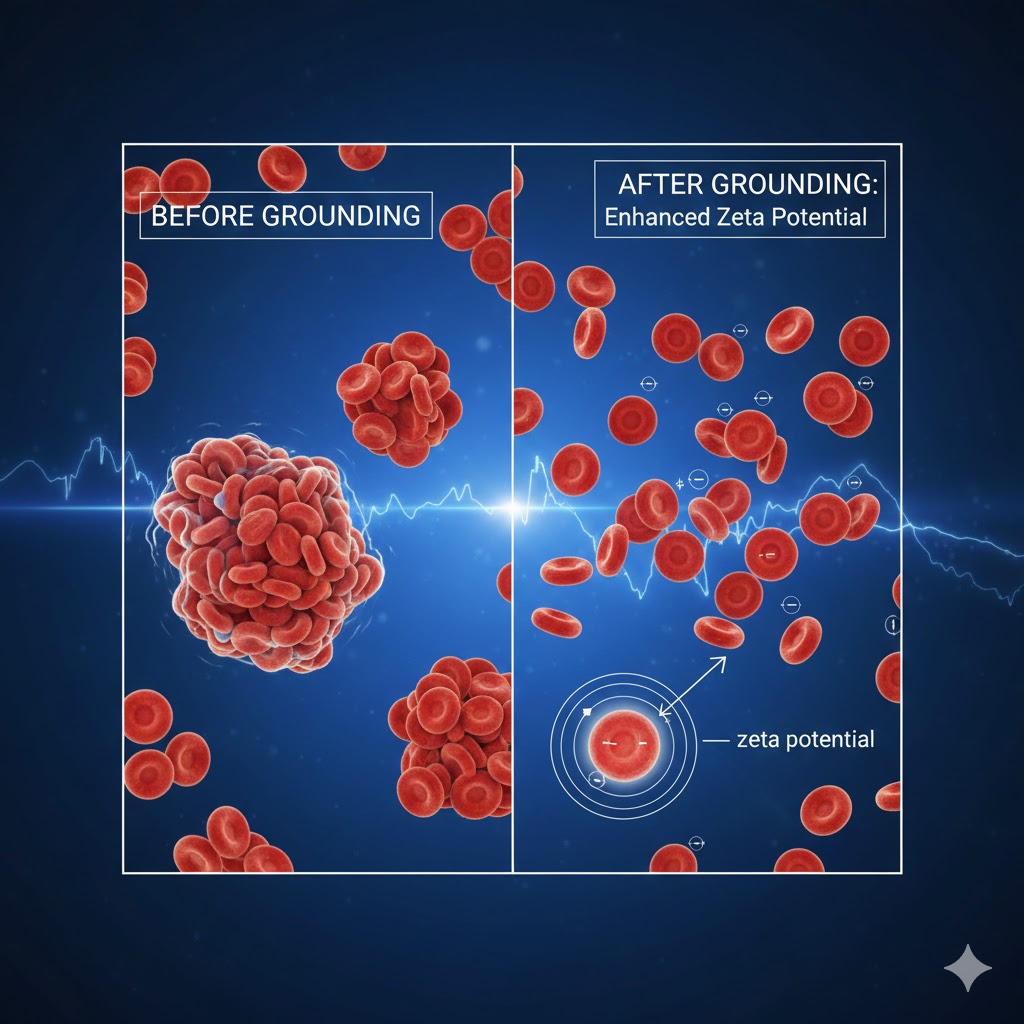
A key element of earthing is its effect on blood rheology (flow properties). In a randomised study, Earthing (Grounding) the Human Body Reduces Blood Viscosity [2], researchers examined how electron transfer affects the blood. The results showed a significant increase in the red blood cells’ zeta potential (electrical charge effect).
- Zeta potential: The electrical charge on the cell surface that ensures the cells repel each other.
- Viscosity: With higher zeta potential, clumping (aggregation) decreases, making the blood less viscous.
This is particularly relevant, as improved circulation optimises oxygen transport and facilitates the removal of metabolic waste products, which is essential in a healing process [1].
Sensory anchoring

Where earthing focuses on DC circuits and electrons, psychological grounding focuses on attention regulation. One of the most widely used techniques is the 5-4-3-2-1 method. It can be practised anywhere—whether you are sitting at your desk or standing in a public space. This is where the prefrontal cortex (frontal lobe) and the amygdala (fear centre) are affected.
The method is an evidence-based technique to interrupt the “fight-or-flight” response. By forcing the brain to perceive and process sensory input, focus shifts from repetitive stressful thoughts to immediate, objective reality.
- See: 5 visible (visual) objects (focuses the sense of sight).
- Touch: 4 tangible (tactile) sensations (activates the somatosensory system (sense of touch)).
- Hear: 3 distinct sounds (stimulates sound processing (auditory processing)).
- Smell: 2 scents (activates the sense of smell (the olfactory system), which has direct access to the emotional centre (the limbic system)).
- Taste: 1 taste sensation (gustatory system) (creates present-moment awareness).
Practical application

Grounding can be practised year-round, but the method must be adapted to the conditions. The most direct approach is always barefoot contact with conductive surfaces such as damp grass, sand, or bare earth (possibly concrete slabs in contact with the ground).
- Outdoors (primary method): 20–30 minutes daily with bare feet on the ground is the most effective way to equalise electrical potential. Water increases conductivity, which is why the beach or damp morning grass is ideal.
- Indoors (supplement): By using grounding mats or sheets connected to an earth connection, you can receive the electrons during sleep or office work [3].
- Managing freezing weather: It is a misconception that grounding necessarily requires bare feet in the grass all year round. Especially in freezing weather, alternatives are essential:
- Conductive materials: You can use silver-thread socks or grounding shoes that conduct electrons through the material.
- Natural antennas: Direct contact with the bark of living trees creates a bridge to the earth’s potential, as the sap in the tree acts as a conductor.
Safety and evidence

When you use grounding equipment indoors (such as mats or sheets), you connect yourself directly to the home’s electrical system via the earth pin. If there are faults in your electrical installations, or if the equipment is not properly secured, you risk current passing through you instead of into the ground. You should therefore ensure that the equipment you buy is technically safe, and that your sockets (or connection to radiator or water pipes (which must not be made of plastic)) have a properly functioning earth connection.
For this reason, reputable grounding equipment is always fitted with a resistor (typically 100k ohm or 1 megaohm) built into the cord. This resistor acts as a safety device that allows the small electrons to pass for grounding, but blocks a strong current so you do not receive an electric shock.
Scientifically, grounding is considered a growing field, where pilot studies have shown promising results for cortisol regulation and improved sleep, but where independent large-scale research is still needed [3].
It should therefore be regarded as a complementary supplement to other treatment.
Check grounding effect
Here you use your grounding equipment’s own connection to check the effect.
Procedure:
- Use a multimeter: Set your multimeter to AC voltage (V~). Choose a low range (e.g., 2 V or 20 V) if it is not automatic.
- Connect to earth: Plug your grounding adapter (the plug for the sheet) into the socket. Hold the black test probe against the metal part of the cable coming out of the adapter, or directly on a metal surface you know is earthed (e.g., an unpainted copper pipe on a radiator).
- Measure your body voltage: Hold the red test probe between your fingers. The number on the display now shows the electrical voltage your body picks up from your surroundings.
- Check the effect: While still holding the red probe, touch your grounding sheet with your other hand.
Result: If your equipment is working correctly, you will see the numbers on the multimeter drop drastically—often almost to zero. This confirms that the voltage is now being conducted away from your body and into the earth connection.
Important detail: For this test to work, it is a prerequisite that the wall socket actually has an active earth connection installed by an electrician. If the numbers do not change at all, it may be because no earth has been wired to that particular socket.
Conclusion

Grounding offers a simple and accessible way to support the body’s natural regulatory mechanisms. Whether you are seeking the physical benefits of earthing through direct contact with the ground, or you need the psychological tools to find calm in a stressful everyday life, it is a method that requires few resources but can have a noticeable effect on well-being.
By integrating small moments of earthing into your daily routine—regardless of the weather—you can create a solid foundation for both physical and mental balance.
Links
[1] The Effects of Grounding on Inflammation, the Immune Response, Wound Healing, and Prevention and Treatment of Chronic Inflammatory and Autoimmune Diseases (PubMed, 2015)
- Content: This comprehensive review explains how free electrons act as antioxidants and reduce inflammation. The article reviews the biophysical mechanisms behind the body’s healing processes.
[2] Earthing (Grounding) the Human Body Reduces Blood Viscosity—a Major Factor in Cardiovascular Disease (PubMed, 2012)
- Content: A randomised study showing how earthing increases the red blood cells’ zeta potential. This leads to lower blood viscosity and thus improved circulation.
[3] The Biologic Effects of Grounding the Human Body during Sleep as Measured by Cortisol Levels and Subjective Reporting of Sleep, Pain, and Stress (PubMed, 2004)
- Content: This study examines overnight grounding and its ability to regulate circadian rhythm through cortisol measurements. Participants reported significantly better sleep and less pain.
[4] What is ‘grounding’, and can it improve my sleep? (Videnskab.dk, 2025)
- Content: The article highlights the grounding trend and its effect on sleep and stress. Using results from randomised, double-blind studies, it examines whether grounded sheets and mats actually have a measurable effect on recovery and sleep duration.
[5] Practical applications of grounding to support health (PubMed, 2022)
- Content: This study describes the earth’s direct current (DC) and how the conductivity of the human body interacts with the global electrical circuit. The article highlights grounding as a clinical tool for prevention and optimisation of the body’s healing state.
Page created:
d. 20.02.26
❤
What you read on I Have Cancer is not a recommendation. Seek qualified guidance.
