

Questionnaire survey uncovers Danish cancer patients
Cancer patients’ experiences, choices, and desires
Summary of the survey
A widespread desire for a different path:
- There were 177 responses in the survey. A significant proportion of the cancer patients surveyed (39%) fully or partially opt out of standard treatment. The primary reason is fear of side effects and loss of quality of life, which points to a desire for more individually tailored pathways.
Lack of support and information:
- The survey documents a widespread experience of lack of information about treatment options and a closed door for dialogue about complementary methods. Only a few experience the system as genuinely supportive of their choices.
Need for increased patient involvement:
- Overall, the results point to an urgent need for a more patient-centered approach. There is a demand for a genuine dialogue where the patient’s values and desire for shared responsibility are recognized as a central part of the treatment.
A survey of Danish cancer patients’ perspectives on treatment pathways, shared responsibility, and information needs:
Introduction
This article highlights, in text and figures, the perspectives of 177 Danish cancer patients (early June 2025) and their experiences with the Danish healthcare system. The survey uncovers their desires for participation in decision-making, their experience of the level of information, and their approach to complementary and alternative methods.
The purpose is to document the challenges experienced by a significant group and identify areas where patient involvement can be strengthened.
Method

Data was collected via an online questionnaire during the period May-June 2025, distributed through social media and the information site jegharkraeft.dk.
The survey is not statistically representative of all Danish cancer patients, as the mere fact that one is a member of a cancer-related group indicates a desire to have influence oneself. Nevertheless, it provides a strong insight into the trends prevailing for the growing group that actively seeks knowledge and takes shared responsibility for their own course.
Main results

1. Treatment choice and opting out
- Opting out: A significant proportion (39%) have fully or partially opted out of the recommended conventional treatment. An additional 9% considered it but did not dare to take the step.
- Motivation for opting out: The primary reason is fear of side effects and ruined quality of life (65.5%). Other reasons include a desire for control over one’s own body (28.7%) and a belief that complementary methods are more effective or less harmful (29.9%).
- Reason for not opting out: Among those who considered opting out but followed the treatment, the primary reason was that they “did not dare to gamble so dramatically” (53.8%). Pressure from practitioners or family was also a decisive factor (30.8%).
2. Use of complementary methods
- Most used methods: Among those who actively use complementary initiatives, dietary supplements (62.1%), dietary changes (50.6%), and physical/mental practices such as yoga and meditation (46%) are the most commonly used.
- The system’s reaction: Only 19.3% experienced the healthcare system as supportive of their choices. Conversely, 22.7% encountered a directly judgmental attitude.
3. Information and involvement
- Lack of information: Over 40% did not feel sufficiently informed about their treatment options.
- Desire for knowledge: A majority want in-depth knowledge of statistics (55%) and the possibility to choose treatment based on a personal assessment of the risk of side effects (50%).
4. The experience of pressure
- Pressure from the system: Almost half (48.8%) experienced some form of pressure to follow standard treatment. For 22.4%, the pressure was “significant” or “transgressive.”
- Absence of pressure: 46% experienced no pressure. However, this group primarily coincides with those who followed the recommended treatment without reservation.
Discussion
The results point to a widespread demand for a more patient-centered approach. Many cancer patients wish to be active partners in their journey but find that the system is not geared for it. For many, the fear of losing quality of life outweighs statistical survival chances, which challenges a system that primarily focuses on the latter.
The lack of openness toward complementary methods and the pressure some patients experience can create unnecessary distance and mistrust. This underscores the need for a more nuanced dialogue where the patient’s values, knowledge, and desires are recognized as an equal part of the basis for decision-making.
Conclusion

The survey paints a picture of proactive and well-informed cancer patients who desire a more personal and inclusive treatment. There is an untapped potential in meeting this desire for more information, greater openness, and a genuine dialogue.
Recognizing and supporting patients’ choices can not only increase satisfaction and the sense of control, but potentially also improve quality of life during and after a cancer journey.
Postscript and data sharing
To promote further research, the questionnaire survey will remain open. Relevant healthcare authorities, researchers, or organizations wishing to access the anonymized data are welcome to inquire. For the sake of clarity, it should be emphasized that no personally identifiable data is linked to the survey.
Hanne Kjær Uhlig
Appendix 1.
Detailed results from the questionnaire survey
Choice of cancer treatment

Thank you very much for agreeing to answer this questionnaire. The purpose is to uncover whether you have made active choices – or have had a desire to do so – in connection with your cancer treatment. And if so, what feelings it has resulted in and what consequences your choices have had – including whether you have opted out of or supplemented conventional treatment with other methods.
Your answers are extremely valuable for understanding patient perspectives better and will be used anonymously for an article. It takes approximately 10 minutes to complete.
0.1 Demographic information
Distribution of cancer types among respondents
- Breast cancer (incl. all subtypes, stages, and spread): 113
- Lung cancer (incl. small cell, non-small cell, and “2 parallel lung cancer”): 12
- Bowel cancer (incl. colon cancer, rectal cancer, colorectal cancer, and mCRC): 9
- Cervical cancer (incl. metastatic cervical cancer): 6
- Kidney cancer: 4
- Lymphoma (incl. Hodgkin’s Lymphoma, diffuse large B-cell lymphoma, and incurable lymphoma): 4
- Brain cancer (incl. “2 tumors in the brain”): 3
- Prostate cancer: 3
- Bladder cancer: 2
- Ovarian cancer: 2
- HPV-related cancer (incl. tongue/trachea and tonsil/lymph nodes): 2
- Neuroendocrine carcinoma: 2
- Bone cancer: 2
- Cancerous tumor (unspecified, e.g., “Cancerous tumor”): 2
- Esophageal cancer: 1
- Malignant melanoma: 1
- Testicular cancer: 1
- Pancreatic cancer: 1
- Vulva: 1
- GIST cancer: 1
- Leukemia: 1
- Throat cancer: 1
- Malignant cancer (unspecified): 1
- None (specified as no cancer): 1
- Unspecified number (specified as “3”): 1
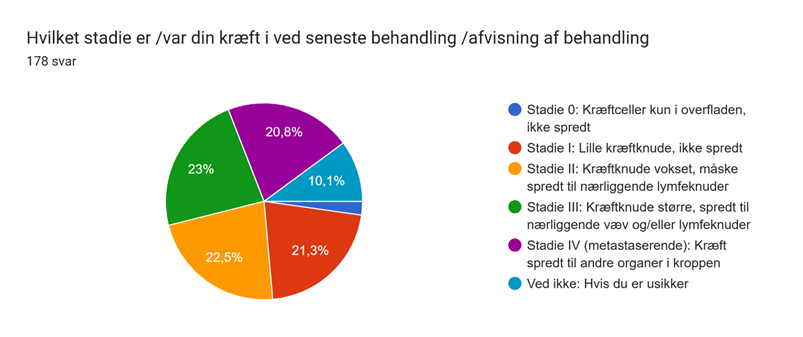
0.2 Demographic information
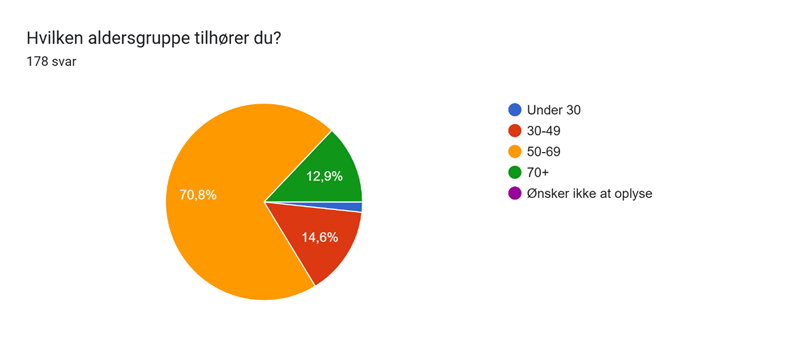
0.3 Demographic information
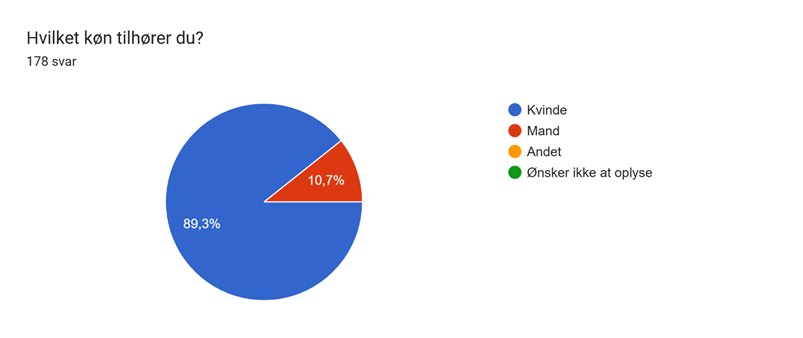
0.4 Demographic information
1.1 Reasons for treatment choice
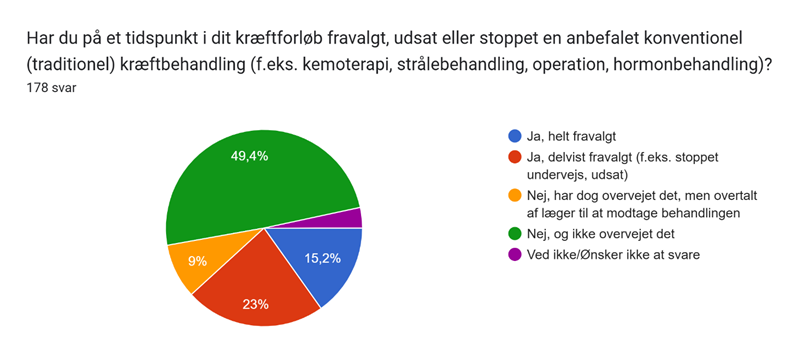
1.2 Reasons for treatment choice
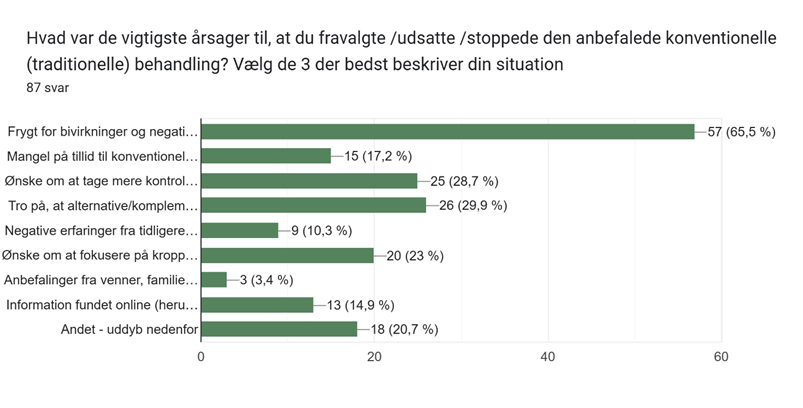
Elaborate (optional) (35 responses)
Selected:
- I answered no to the previous question. However, I have had unwanted/severe side effects from the third round of chemo. It was the doctors who said stop and recommended a dose reduction immediately! I feel very heard and I really feel the doctors see you as a human being who must be able to manage daily life despite treatment.
- Opted out of follow-up chemo (gemcitabine) after surgery, as a Danish scientific article shows it is more harmful than beneficial. Opted out of weekly Gemcitabine treatment for bile duct obstruction. It turned out that it was not a case of cancer.
- Opted out of preventive chemo 8 years ago, the cancer is now back as a metastasis… “Fear” of side effects is not the right description; the side effects were there and had a major impact on quality of life. Due to age, I did not want the rest of my life ruined with side effects.
- I investigated how much the chemo and radiation recommended by the doctors would help my survival. The percentage was too small (2% and 5% respectively) for me to want to expose myself to the risk of side effects.
1.3 Reasons for treatment choice
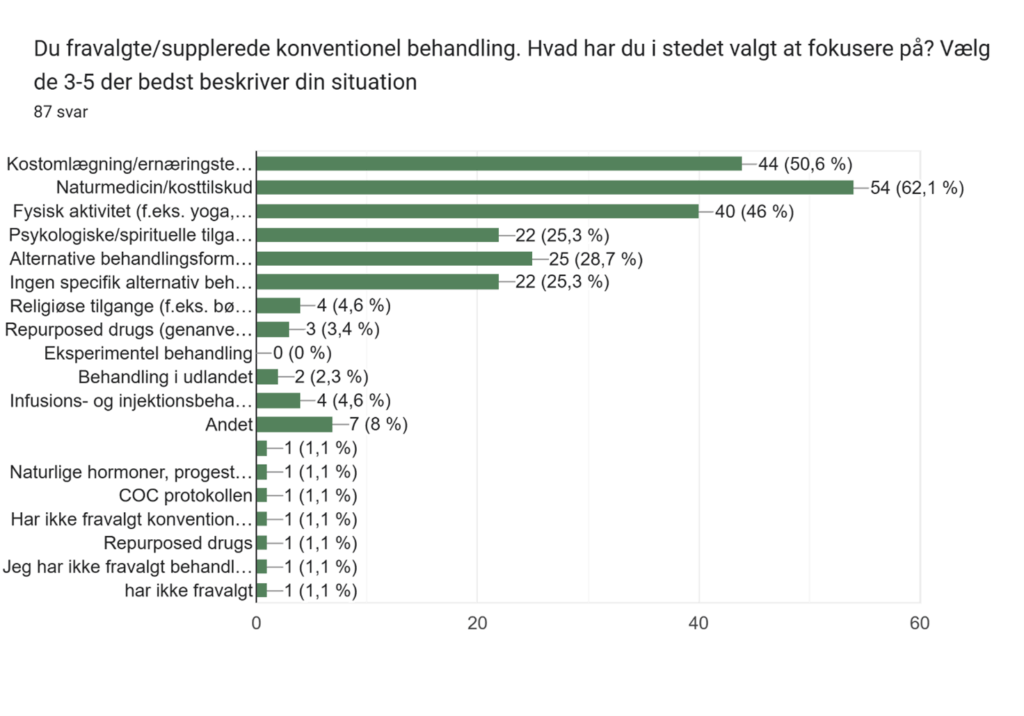
Elaborate (optional) (18 responses)
Selected:
- Coc
- Had hormone balance tested in Germany both at the start and later. It has provided an overview.
- For 1 year now, I have postponed/opted out of surgery. Quality of life is more important to me than length of life. Hjertemagnyl, LDN, melatonin, metformin, Vermox, simvastatin, many dietary supplements
- Anthroposophic medicine as in Germany.
1.3A Reasons for treatment choice
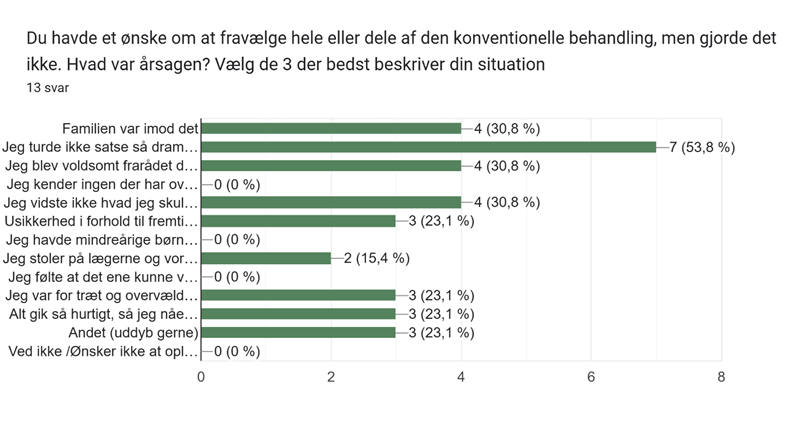
Elaborate (optional) (5 responses)
Selected:
- If I got breast cancer again, I would feel that it was my fault because I opted out of treatment.
- Actually, I want to take more drastic measures against the cancer. The doctors only want to keep it stable.
- I was afraid of others’ reactions; if what I did outside the hospital system didn’t help, then everyone would say she brought it on herself. But if I try their things first, and it returns anyway, people will say they feel sorry for me. And I can’t manage the alternative market at all, so I’m trying supplements on the side and starting chemo on Monday. But deep down, I believe I should rebuild myself to get well, and I am seriously afraid that I won’t be able to do that with all the intense treatments I have to go through. So I don’t feel true to myself, and I am not at all comfortable with all the hospital’s treatments.
2.1 Experience of dialogue and information with the healthcare system
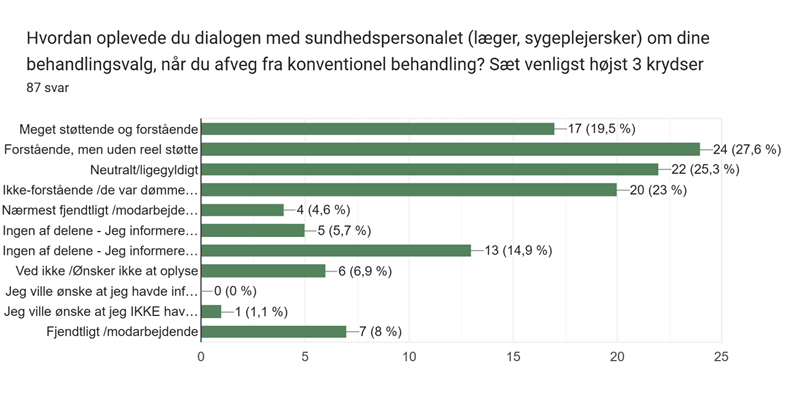
2.2 Experience of dialogue and information with the healthcare system
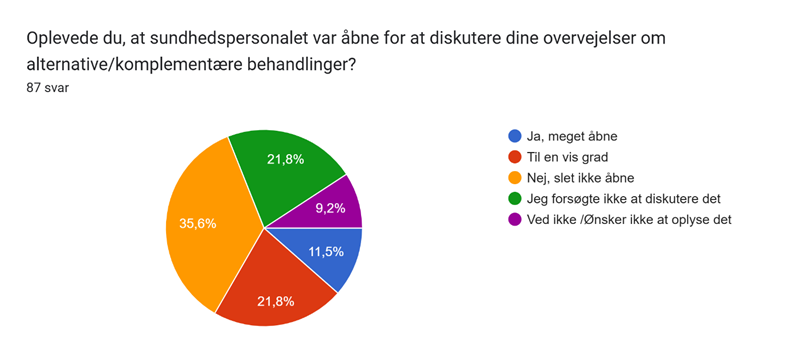
2.3 Experience of dialogue and information with the healthcare system
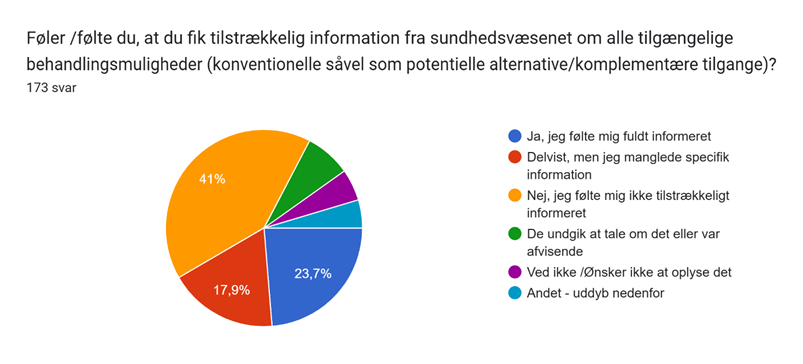
Elaborate (optional) (46 responses)
Selected:
- Not at all
- I requested studies that formed the basis of their treatment strategy, but they could not provide them to me. I don’t think they know enough about alternative treatment, so I didn’t seek their advice in that regard
- They made a plan, and that was it. There was NEVER any talk about alternative/complementary approaches
- oncologists and surgeons are non-holistic doctors, and I question whether one can call oneself a doctor as a non-holistic physician. A sick, sick system, and let’s say it plainly: fully dominated by the pharmaceutical industry. Life-threatening doctors. Shocking.
- Had to choose for myself whether I wanted surgery before or after chemo; I would have liked them to guide me more regarding pros and cons. Chose to have surgery first.
- None of the doctors I have been in contact with have informed me about alternative approaches. And I don’t think they can inform/recommend when they don’t believe there is evidence. In some cases, however, I believe their knowledge base may be too poor. For example, there are treatment practices and knowledge in other countries that they apparently aren’t aware of. There are likely many examples, but the use of cold caps is one of them. Some doctors issue terrible warnings, while in a long list of European countries they are used as a standard offering – based on scientific research.
- No information about late effects; I have read about that since
- It is very difficult to get honest prognoses
- Believe that the doctors know best
- Was exclusively informed about conventional methods
- They actually don’t know much about complementary forms of treatment, and what they do know, they don’t believe in
- No orientation regarding alternative treatment options. Only warnings.
- Received no information about an alternative approach
- There was only one option and it could not be discussed. I wanted low-dose with only one chemo product but had to have high-dose with all four products.
- Alternative treatment – even dietary supplements – has been completely taboo among the doctors I have met
- Fully informed about the conventional – the treatment recommended as standard treatment that the doctors can vouch for. HAVE ALWAYS felt like a partner and listened to. We have collaborated, the doctors have told me about options, and I have CHOSEN
- For me, it is the completely wrong approach – I am calmed by knowing the data; but I have not yet succeeded in getting them to understand and accommodate this.
- Wanted to continue with my natural supplements, but the doctor forbade me from doing so.
- Lack information especially about alternative treatment of, in particular, side effects of anti-hormone treatment
- I met no one in the established treatment system who knew anything about possible alternative or complementary treatment methods. I have researched everything myself
- They won’t take a position on anything at all. I made a list of my supplements, but they knew nothing and said I could just settle for a multivitamin pill, and if my liver numbers increased because of supplements (which I have taken for a long time without increased liver numbers), then I simply couldn’t receive chemo. So they are very uncooperative.
2.4 Experience of dialogue and information with the healthcare system
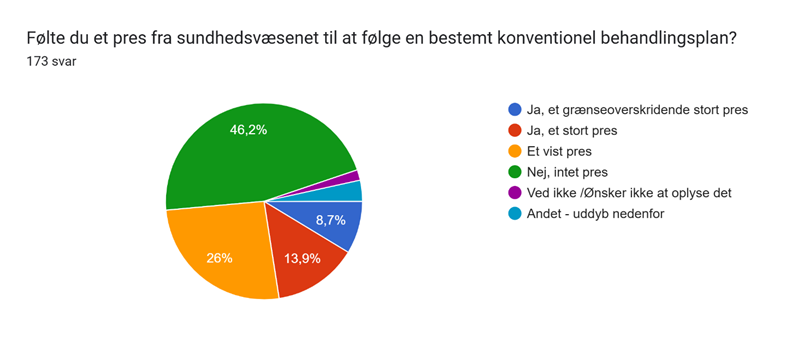
Elaborate (optional) (31 responses)
Selected:
- Both doctors and nurses have been very responsive to my concerns and reflections. I also had extra appointments to be sure of my choice, for example, regarding surgery, whether I should choose breast-conserving surgery or bilateral mastectomy.
- No, because “that’s just how it was done.”
- There was no choice if I wanted to live; that was the feeling one got. But they would never calculate the probability.
- I was told that I am gambling with my life by not accepting treatment. The gambling is also present with medical treatment, but we didn’t discuss that.
- Doctors often say IT IS YOUR CHOICE, and when you are only presented with conventional options and they do not wish to engage in dialogue about alternatives, you are almost pressured into saying yes to the conventional offer. But it is understandable that the individual doctor does not dare go against the system and, moreover, has been convinced throughout their education that conventional treatment is the only right one. It is the entire prevailing discourse in the biomedical field that needs a counterpoint.
- Cisplatin, which caused damage (nerve inflammation and a blood clot in the brain). Was told that radiation therapy doesn’t work well enough on bladder cancer, but received it anyway. Was later informed that it doesn’t work but causes damage when you have two artificial hips.
- No alternatives were presented. But ChatGPT doesn’t know any others either.
- They tried to persuade my husband to turn against me and stand with them.
- I was just asked. Didn’t feel pressure. However, there were no other options.
- “This is the plan we have”
- Was very pressured
- They refuse to talk about supplements or other alternative measures. Dismiss them and say they know nothing about it.
- I was told, among other things, that I could go home and enjoy my final days since I was opting out of chemo!!
- No doubt that what they offer is okay
- The dialogue during the first consultation with the chief physician was shocking to me. I thought I had more say in the process.
- Pressure, or rather a “strong recommendation,” that I didn’t dare say no to at all. (But fortunately, the treatment worked for me). It was difficult to get real information to be able to make decisions on a qualified basis.
- I felt poorly treated and got no overview of my illness or why/why not treatment. It was below all standard. Didn’t get any thorough answers when I asked and felt ridiculed if I wanted more detailed answers.
3.1 Consequences of treatment choice
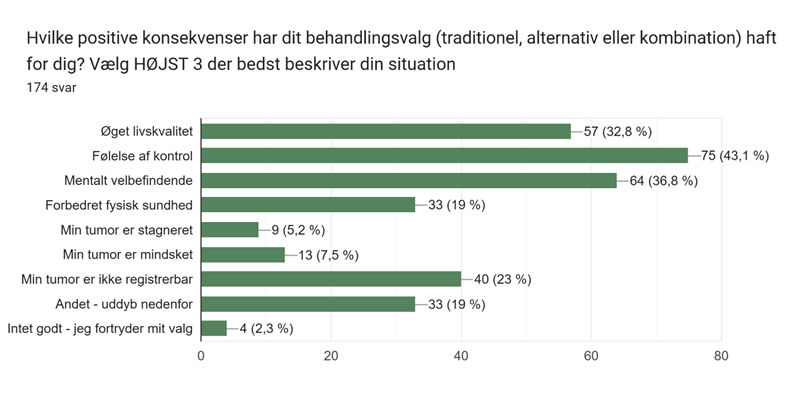
Elaborate (optional) (52 responses)
Selected:
- Traditional treatment in the form of radiation (which did not work on my cancer) meant that when I was supposed to have chemo, I could not receive all the types of chemo I should have, as the radiation increased the chance of fistulas if I received a certain type of chemo. I have personally started alternative treatment, which has given me more energy and a sense of regaining control. In that way, I still feel I have a life to fight for now that traditional treatment has been abandoned.
- I have been gifted 49 years.
- Avoided a lot of nasty side effects from a treatment that wouldn’t have changed anything.
- Did not feel sick before my cancer was discovered. Subsequently experienced side effects from treatment.
- I have been doing well. No concern about side effects. Unfortunately, the tumor has slightly increased recently, so I have changed strategy.
- survival, unlike those patients who took gemcitabine until the bitter end. 1.5% are alive after 3 years. Murder on an assembly line.
- According to the doctors, my cancer is in a stable period. I am under surveillance, which is nonsense because it just means a PSA blood test every six months with my own GP and nothing else.
- Limited extended lifespan.
- My tumor is gone, and I choose to believe that chemo has completely cleared me.
- I have metastases on the liver + node on the mediastinum; the node is currently stagnant.
- Had I been informed about side effects and received info about the effect of chemo and radiation, I think I would have opted out.
- I had no control or choice. Now I’m here on anti-hormones and with a plastic implant that looks strange. The message is that as long as they look fine with a bra, they won’t do anything more about it. I had the brand Mentor inserted and have read that it is frequently used because it is cheap. I would have liked the possibility of a choice… perhaps paying for a better implant myself. In the same way that you can choose hearing aids and receive a subsidy. The implant is part of my body and I’m “stuck” with it now. It’s not fair 😓
- Only scar tissue in the lungs after immunotherapy (and self-treatment with alternative measures, including lessons learned from the “Radio Doctor”).
- I use many different forms of complementary methods and take my one pill a day from my oncologists.
- It’s nice to contribute myself.
- Have many side effects and late effects.
- Am still tormented by metastases in the bones. But I am gradually finding peace in accepting that I live with metastases.
- It helped my children to believe that I would do everything to get well.
- Despite the prohibition, I have resumed taking supplements. And I have now also chosen to take cannabis, THC, and mushrooms along with chemo.
3.2 Consequences of treatment choice
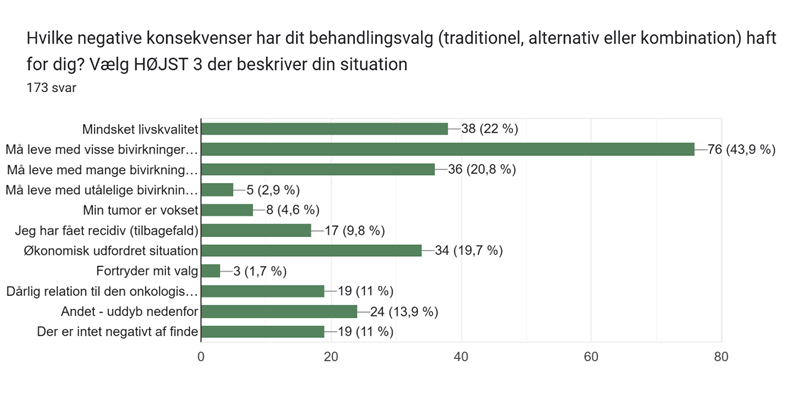
Elaborate (optional) (40 responses)
Selected:
Only a few examples out of 40 elaborations are mentioned here. We are all familiar with these from the news media.
- For many years, I have had severe late effects – lung and heart problems, poor circulation in my left arm, and the nails on my left hand have been damaged.
- The side effects of follow-up treatment are unbearable. The late effects are massive, and it is difficult to find peace with them alongside the side effects. My body is broken, but I am alive.
- There is a severe loss of quality of life with anti-hormone treatment; potency is affected (even though I have managed relatively well, I am still challenged). In addition, there are the expected side effects, with hot flashes that come in periods. Not that I regret any treatments, but they come at a price.
3.3 Consequences of treatment choice
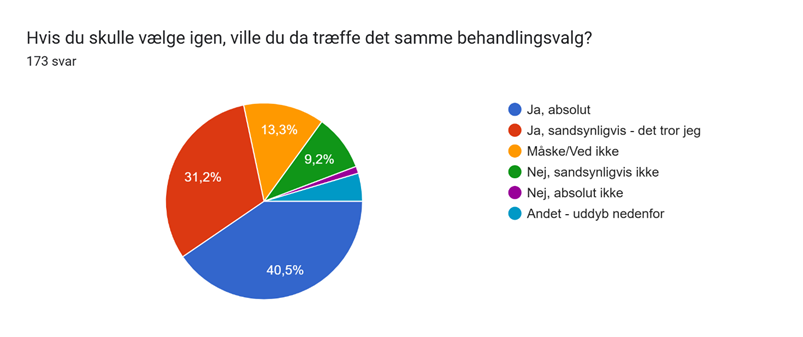
I find this response particularly interesting, as a very large number of respondents are satisfied with the choices they have made – whether they opted for or against traditional treatment. Only a total of nearly 23% are in doubt or would probably choose differently. And just 1.2% would definitely have chosen differently.
Elaborate (optional) (22 responses)
Selected:
- Would probably have opted out of chemo, if that makes sense
- I have, after all, been gifted life and a lovely life.
- But I would have liked to have been in dialogue with the healthcare system about what I could do differently myself – diet – weight – exercise, etc.
- Would not have received such high doses of immunotherapy, two types on the same day, which destroyed my thyroid. Would have discontinued chemotherapy when chemoresistance occurred. Would have initiated alternative treatment from day 1.
- As long as the alternatives to the conventional are not (more easily) accessible to me, I don’t dare say no to, for example, chemo. Much more funding must be allocated to research into alternative treatment methods. Including methods used abroad.
- I am so respectful of authority that I don’t dare do otherwise.
- I would have insisted on knowing more about the implant that has been placed in my body. I hate the one I have now.
- I have regretted accepting some chemo treatment. I should have chosen the alternative path I have taken from the start and opted out of chemo.
- I would not go through a course of preventive chemo after the surgery.
- In reality, I have no choice other than what they suggest! Take it or leave it; the right choices are not available, nor is the choice of region, where there is a big difference in what you are offered.
- I would have said no to radiation if I had to do it over. Didn’t get nearly enough information about side effects and what it can mean for a possible plastic surgery. They totally downplayed the radiation!
- I didn’t opt for alternative treatment from the start; I would have done that if I had the knowledge and oversight.
4.1 Consequences of treatment choice
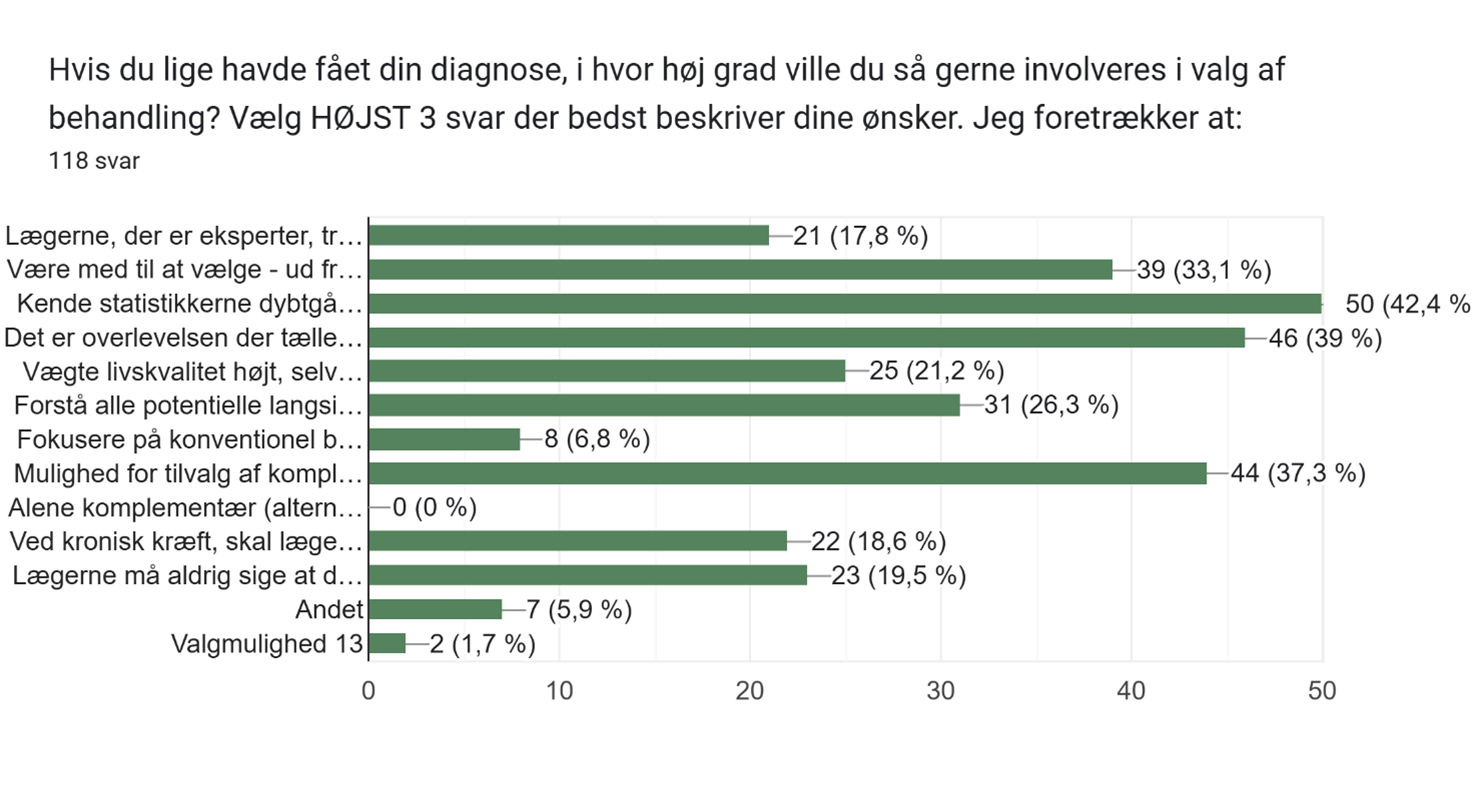
4.1 Consequences of treatment choice
Elaborate (optional) (10 responses)
Selected:
This question is one of the few that was added later (from respondent 57).
- I was 37 at the time. So life-prolonging treatment was what mattered most.
- It is not necessary to accept treatment that invalidates the patient. These are medieval methods that should be prohibited and punishable. The side effects and lack of efficacy of chemotherapy must be brought to light. It is the worst toxic filth.
- That one is offered the best possible treatment and that there was patient involvement; unfortunately, that is not the case.
- Also the possibility of opting for complementary (alternative) treatment under medical supervision.
- Could wish that there was collaboration between alternative and medical treatment.
- Aalborg doesn’t let you choose at all. I can see that they do that in Vejle/Odense. They could learn something from that. And it’s not just the doctors, but definitely also the nurses.
- I want the doctors to give me the opportunity to say yes or no on a medically informed basis.
4.2 Future desires and recommendations – Free text
What could the healthcare system do better for patients – including those considering opting out of or supplementing conventional (traditional) treatment?
Elaborate (optional) (131 responses)
Selected:
- Educate both doctors and nurses in acceptance, knowledge, and understanding of alternative treatment.
- Since the pharmaceutical industry has overall control of our healthcare system’s conventional offerings, they are not interested in us getting well😡 One proposal could be that a strong team of, for example, doctors without sponsors and a task force met with our Minister of Health. These could seek out the German health authorities and adopt the model of a system where citizens freely choose between complementary and conventional treatment and the healthcare system pays for both; plus, German doctors have great insight into the effects of complementary treatments.
- Healthcare staff could become better at making it clear that their treatment plan is a suggestion that the patient can choose to accept or decline. With cancer, however, it is important to emphasize the consequences of opting out of conventional, documented treatment. But it is always up to the individual patient.
- Careful and open-minded in counseling and treatment. The coordinator is a central person here.
- Have a greater understanding that medicine is not the solution for everyone.
- Stop having so much anxiety about the fact that alternatives exist.
- It would be wonderful if we patients could openly talk about the alternative methods we also use. Even though my oncologist is very understanding, he is not inclined to discuss alternative treatment.
- That follow-up treatment – radiation and chemo – does not have such MAJOR consequences.
- Experienced a big difference between Skejby (lack of dialogue and the impression of having to choose their entire package) and Vejle (which I switched to; dialogue and the opportunity for surgery without chemo and radiation). The healthcare system should see the individual person from a holistic perspective – also focusing on their resources/healing powers.
- They could use the existing possibilities to investigate which treatments would make sense instead of just starting from one end with treatment and hoping it works. DNA technology exists but is not used in Denmark.
- Free treatment for late effects and side effects such as free dental treatment, lymph physiotherapy, foot and nail care, joint and muscle massage – 4 areas that everyone is affected by and cost so much money that one does not receive the necessary treatment to keep late effects and side effects at bay. Psychologist hours should be offered to everyone 3-4 months after the last treatment.
- I think I was poorly guided regarding diet and vitamins. Was recommended vitamins that I subsequently found out could reduce the effect of chemo. There were no recommendations regarding diet.
- Be open and not use threats and fear as pressure.
- Have a better understanding that people want to supplement with alternative treatment. And that one wants to take responsibility for one’s own life.
- Support the choice we take instead.
- Information about treatment and information about late effects.
- Hire former cancer patients who have been cured through alternative treatment and cooperation, so that everything is exhausted or tried.
- Educate doctors holistically so they understand the importance of diet, psyche, yoga, exercise, meditation; be open to TCM and Ayurvedic practice, which is recognized by the WHO as a holistic medical system. Do not hide statistics, but prepare studies of evidence for chemo, operation, and radiation therapy.
- Openness toward unconventional treatment, financial support.
- I would have liked an overview of how risky my situation was. Compare with others and perhaps see cases of others’ progress.
- Provide more information about alternative treatments.
- Much more must be done to inform about subsequent treatment for late effects. By doing so, one would already have more information to be able to choose the correct treatment of one’s own choice/mind.
- I have been to 4 medical consultations with as many doctors. It would be nice to have the same one that you got to know and feel comfortable talking openly with about supplementary treatment options.
- In my case – open up to talking about an end-of-life plan instead of a treatment plan.
- Maybe not start out so harshly that the treatment causes damage.
- That one was more open to both conventional and alternative treatments. Use the best from both “shelves”.
- It is not the individual patient who needs to be helped. It is entire treatment systems that must work toward incorporating alternative knowledge and methods.
- That the money I cost, I could take with me to alternative treatment. And that I could choose for myself what should be cut.
- Inform. Guide. Point in the direction of different possibilities. I experience them as frightened and limited, especially in conversations about supplements.
- Better inform about late effects and alternative methods.
- Give more information… but there is no time to talk with the individual person. The message I have most often received is: everything is fine… goodbye. – Had 4 weeks with an infected hole into my implant. Was eventually operated on again. – I itch and crawl all over my body and have been told that I should just take a break from anti-hormones.
- Become better at understanding that patients may have other illnesses that could be a reason to create a different plan than their standard package. I know it can provoke the doctor when one doesn’t want to follow their package deal, as it requires more from the doctor.
- Stop discouraging but support and inform.
- Be listening, open, supportive, and interested in the patient and the process of healing, regardless of choice.
- Complementary nurse.
- Collaborate with alternative/complementary practitioners. As in Germany, for example.
- Open dialogue and interest from the public sector regarding alternative options.
- Educate holistically… see the whole person… and possibilities that lie outside their world.
- Inform about alternatives, including treatment abroad.
- Be welcoming and informative and open in dialogue and accept the patient’s choice.
- Doctors should educate themselves in nutrition, mindfulness, hormone balance, and the various alternative treatment methods.
- Be curious. Hear what people are doing and consider implementing or learning about the benefits of it, even if some choose to take chemo at the same time.
- I want a much higher degree of knowledge about and openness toward alternative treatment and supportive treatment (such as reflexology for preserving sensation in toes).
- First and foremost, move. Do not dismiss discomfort and side effects that haven’t already been described. It is deeply frustrating to be told that the side effect doesn’t exist when you can see that it does. And I would like them to cooperate in terms of including alternative treatments and approaches, but already explore them themselves or be willing to try them.
- The healthcare system is based on research and evidence, so it is difficult to combine conventional treatment with alternative treatment. I think lifestyle should be much more in focus for cancer diseases, as changes in diet, etc., can improve the prognosis and quality of life.
- Provide the possibility to get supplements and an explanation of what works.
- Inform that there are other or supplementary treatments than the conventional one.
- Support and help in alternative choices.
- Be welcoming toward alternative treatment. Use alternative treatment alongside conventional treatment.
- Cooperate instead of judging and washing their hands when they don’t do their job. I have recurrent cancer because I was operated on too late! Day 42 after finishing chemo; the PET/CT was on day 14 where I would have been operated on to be cancer-free.
- Open their eyes to, for example, repurposed drugs, but I hardly believe that will happen, unfortunately!
4.3 Future desires and recommendations – Free text
What is your most important advice for other cancer patients facing similar treatment choices?
Elaborate (optional) (143 responses)
Selected:
- Get proper information and demand a doctor who can speak so you understand – if you need details, say so. We are different.
- Seek information and knowledge about which treatment will fit best in your situation.
- Take a family member or a friend with you to radiation or chemo.
- Seek knowledge about complementary treatment; take control of your body. Our body is very competent, and if it is given strength with the right ingredients, it repairs itself.
- Investigate your type of cancer; read about it on sundhed.dk or other places where you are sure the information is based on professional documentation. Remember that you are an individual and cannot compare yourself to others – not even if they are in the same age group with the same disease. There are hereditary factors, living conditions, and your own requirements for quality of life. If you don’t feel on the same wavelength as the medical staff, ask for another one. Chemistry/rapport is incredibly important for feeling seen and heard.
- Take control.
- Seek information and help. I joined “Tidslerne” (The Thistles), which works for an alternative approach, and then I was very active in the municipality’s center for cancer and health, where I, among other things, sought out and participated in the “Body and Cancer” program. I created a Facebook group for family and friends where I regularly shared status updates – so everyone was informed.
- Contact a natural hormone therapist. They are trained in the field and have far greater knowledge.
- What consequences can the treatment have regarding potential future treatment. If the first treatment doesn’t work, what does that mean for a potential second treatment.
- It is your illness; you are the one who decides.
- Feel what is right and be proactive.
- Be part of deciding what you will agree to and what you do not want!
- Read others’ stories about their process; investigate side effects and the survival rate.
- Think of yourself and your quality of life.
- It is so individual – so…
- Listen to your inner voice.
- Join Tidslerne, read about non-conventional treatment, use competent alternative practitioners, e.g., Livlægerne in Kolding. Go for what you trust and believe in.
- Do not take the hospital’s statements at face value. Investigate other methods. Take control. Believe in it. Feel if it feels right.
- Talk it through thoroughly and listen to what is right for you.
- Familiarize yourself with your illness and be critical.
- Remember to listen to yourself throughout the entire process.
- Go on sick leave and be prepared for the fact that the hard part comes mentally afterward.
- Hm … it’s hard to say.
- Feel what feels right for you.
- Do research BEFORE you let yourself be pressured in a vulnerable situation. Take the lead and demand time BEFORE giving your answer.
- Accept the treatment with confidence.
- Use network groups on social media to meet like-minded people and exchange experiences.
- To be informed that there is an alternative solution.
- Believe that you will make it.
- Enjoy life while you have it and make the best of each day.
- Find peace in your decision and remember it is your decision. Take time (if you can) to investigate and ask everything you can. Look up. There may be other paths that result in fewer side effects or late effects, depending on how serious your cancer is.
- Join Facebook groups – that’s where I have gained a lot of knowledge – also discovered how differently we have been informed. But that just makes you wiser yourself – so it’s perfectly fine that we are informed differently.
- Thoroughly investigate which side effects and late effects one gets after conventional treatment.
- Supplement with plenty of alternative treatment and ignore the oncologists’ doomsday prophecies.
- Only think positively, then everything will be fine.
- Listen to the advice of the professional staff.
- Take all opinions into account and ask and discuss everything with close friends and family, and be open to other opinions.
- Fear the Danish healthcare system.
- Ask questions and keep asking; also ask for a second opinion if you are unsure. Make demands of the doctors, even if they are dismissive.
- Ask the doctors and nurses and demand answers. Seek additional info yourself.
- Be an eagle in your own diagnosis and bombard them with questions and expectations for treatment.
- If possible, contact others in the same situation AND avoid charlatans on the net.
- Follow your heart.
- Ask for time to think, so you don’t say yes to treatment before you have the necessary knowledge and have thought through the consequences of a yes.
- Trust the doctors in the first instance.
- We are all different. But “take some time to think/feel it through. Cancer packages are express trains, but you can slow them down a bit”.
- It is you who decides over the cancer, not the cancer that decides over you.
- Investigate for yourself whether treatment is optimal.
- Listen to your gut; you should feel good about the treatments and the process.
- Feel yourself, and then it’s okay to doubt and question treatment.
- Feel what you want to participate in. Quantity or quality. Usually don’t give advice!
- Go with your gut feeling. Choose YOUR own path. No two people are alike.
- Read literature on alternative treatment methods and orient yourself on what others have done – with what results. For example, via Facebook groups for people with (breast) cancer. I have received a lot of good information on Facebook, though also much that is misleading/incorrect.
- Have none, as most people are afraid of dying and therefore put their trust in the public sector. I want to take responsibility myself.
- Find a friend who has the energy to investigate and explore alternative paths with you. Trust yourself. Feel what is right. I fired my first oncologist. I wrote a long letter to her about my expectations and that I/we felt our cooperation should end.
- Listen to your feelings and thoroughly familiarize yourself with what treatment is offered.
- You need to be resourceful and have control over your treatment process.
- Make sure to be in good shape. I got through both chemo and radiation relatively well.
- Have patience… there is an insane amount of waiting time, and suddenly a fixed plan is set for everything. So ask questions and insist on knowing more.
- Choose based on informed knowledge, and trust that your choice is the right one for you.
- Listen to your gut and make the choices that are right for you. Only you know the answer.
- Follow the doctors. They are the ones who are specialized, not Google or another platform.
- Listen to yourself and create your own story. I regret that I didn’t go on sick leave for a period.
- Ask about all possible side effects and make sure to obtain information about alternative treatment and self-treatment yourself.
- Listen to your gut feeling. It is your life.
- Seek advice and guidance from like-minded people.
- Always ask in-depth questions, regardless of whether you might not like the answer. You must not be left with a feeling that there were questions you didn’t get to ask.
- Be part of the process and read up on the subject.
- Be positive. Try to find a good mood.
- Be positive and believe that everything will be okay. With a positive mind, everything goes a little easier.
- Always have a relative with you at consultations.
- Seek advice on complementary methods. Read relevant literature. In my case, I can specifically recommend Betina Krohn Wellendorph: Breast Cancer, a Prevention and Survival Guide. Anette and Jens-Ole Paulin: Natural Hormone Therapy.
- Investigate all possibilities for treatment and especially prevention of relapse.
- Be positive, open, and honest with doctors, practitioners, family, and friends…
- Educate yourself in complementary methods, or ask your loved ones to do so… a new world of hope and possibilities opens up.
- For me, the right thing to do was EVERYTHING the doctors said. After all, they have the highest knowledge.
- That they should think carefully before participating in treatments that will, with quite high certainty, lead to side effects.
- Listen to your gut feeling, trust yourself.
- Follow what feels right for you.
- Make the choice on an informed basis and look at alternative ways to strengthen the immune system, and take the time to make the absolute right choice.
- Take your time to discover different alternative forms of treatment. Find out what you can do yourself to improve your situation. Most cancers take years to grow large, so take your time to gain knowledge about your own situation. Join various cancer associations… e.g., Tidslerne (which is for both conventionally and alternatively treated patients); ask your questions in these forums (and NOT your neighbor or friends). There is ALWAYS hope. BELIEVE IN YOUR HEALING. Take time to enjoy life. UNPLUG from the rat race and give yourself permission (perhaps for the first time in your entire life) to do absolutely nothing. I BELIEVE IN YOU 😘.
- Listen to yourself. Take your time to think no matter how bad it is. Do not panic.
- In Denmark: Join Tidslerne, use jegharkraeft.dk. Bring a relative to the consultations.
- The late effects are hard to live with, so think carefully before you enter a conventional course of chemo-(surgery)-radiation-chemo.
- Listen to your inner self and stand firm. Don’t be influenced by the doctors’ horror scenarios and ask for in-depth answers and calculations regarding exactly how much you will benefit from chemo and other treatments. It is important to be able to make an informed choice yourself.
- Stand strong in yourself and be prepared for the fact that you might have to stand alone.
- In my opinion, cancer should be taken as a huge challenge, and it is important that you are involved and experience having control over your own life. Opting out of conventional treatment is a difficult choice with unpredictable consequences.
- Think carefully and listen to your gut.
- Accept conventional treatment.
Page created: August 4, 2025 – published: October 7, 2025
❤
What you read on I Have Cancer is not a recommendation. Seek professional guidance.
